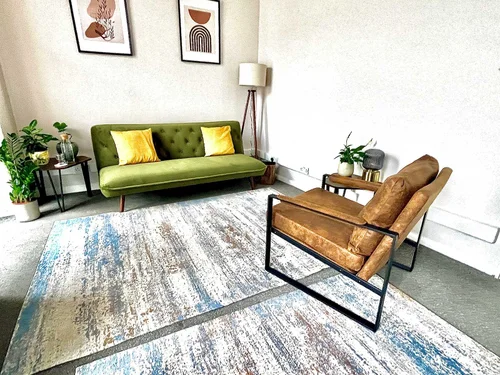
Angel, Islington.
Relationship and couple therapy in Angel, Islington. Five minutes from Angel tube.
Why people choose this room.
The Angel practice is on City Road, between Angel and Old Street, in one of the busiest and most connected parts of north central London. The people who come to this room are genuinely mixed: young professionals in their late twenties and early thirties, people in their thirties and forties working in marketing, research, design, tech, and creative roles, and a steady stream of people who live in Islington, Hackney, Shoreditch, and the wider stretch of north and east London. Many work in the City but live north of the river, and Angel is the natural meeting point.
What tends to draw people here is partly the location. It's quick to get to from Old Street, King's Cross, and the Northern line, and easy to slot a session into the working week. But it's also the kind of room people often choose when they want therapy to feel modern and unfussy rather than formal. Whether you're coming for relationship work with a partner, navigating dynamics in a polycule, or individual sessions on how you show up in your relationships, this is a space that feels grounded rather than clinical.
What tends to bring couples to the Angel room.
Compared with the other practice rooms, the work in Angel often happens at an earlier stage of the relationship. Many of the couples seen here have not done therapy before, are not yet sure whether they will stay together, and are facing a decision rather than untangling decades of pattern. Some of the most common themes:
Deciding whether to commit
Couples who have been together a year or two, circling questions about moving in, exclusivity, or where the relationship is going.
Early cohabitation
The shock of living together; sharing space, money, family time, and domestic labour bringing differences to the surface.
Pre-marital & engagement work
Couples wanting to use the run-up to a wedding to do honest work on the relationship, not just the logistics.
Whether to have children
Differences in timing or certainty, fertility uncertainty, or one partner wanting children and the other not.
Communication feeling stuck
The same arguments returning, feeling unheard, or the relationship quietly drifting rather than being in crisis.
Sex, desire & intimacy
Differences in libido, the impact of stress on closeness, and working out an honest sexual fit together.
Most couples arrive with some mix of these. The work isn't about labelling what's wrong; it's about understanding the pattern between you and helping you do something different inside it.
How I work.
I'm an integrative psychotherapist. With couples, the influences I draw on most are Imago Relationship Therapy, emotionally focused therapy, attachment theory, and systemic thinking. In plain terms: I'm interested in what each of you is actually feeling underneath what you're saying, in how your earlier experiences of love and family shaped what you each bring into the relationship now, and in the pattern the two of you have built between you, often without realising it.
Sessions are 50 minutes. The first few tend to be about getting a clear picture of what's happening: hearing each of you, mapping the recurring dynamic, understanding the history. From there the work becomes more active; naming what I see between you, slowing arguments down as they happen in the room, and giving each of you a chance to be heard in a way that has often stopped being possible at home.
Many of the couples who come to Angel have never done therapy before, individually or together. If that's you, you don't need to arrive with a clean account of what's wrong, or the right vocabulary, or even with both of you fully on board; it's fine to come uncertain. I do not take sides, and I am not a referee. I will, when it helps, push back on both of you. I work with couples across the spectrum, including straight, gay, and queer couples, non-monogamous and polyamorous couples, and intercultural couples.
The consultation and your first session.
These are your first two meetings with me. They're designed to be straightforward and to ease you in without pressure.
The consultation is 30 minutes. I'll explain how I work and what to expect from therapy. You'll tell me what's brought you in and what you're hoping for. If you're comfortable, I'll take notes with your approval. Then I'll walk you through the practical side of things, including how booking works, costs, and what happens between sessions. There's no assessment, no pressure to commit to anything. It's a chance for us to see if working together feels right.
At the end of the consultation, we'll talk about how often you want to come. I usually recommend weekly sessions. Consistent weekly contact helps the work develop and means you're less likely to lose momentum. Ad-hoc slots can't be guaranteed week to week, so if you're hoping to come regularly, weekly is the more reliable option. If you're working through something very specific and focused, we can talk about what might work, but weekly tends to be the foundation I suggest.
If you want to proceed after the consultation, we'll book your first proper session. This is 50 minutes. We get to know each other more. You'll each have more space and time to say what's brought you in and what the relationship looks like from your perspective. I'm listening and understanding the dynamics. We're not trying to fix anything yet. You'll leave with a clearer picture of what you want from therapy and a sense of how we'll work together.
Fees.
Individual sessions are £80 (or £90 for ad-hoc). Couples therapy sessions in Angel are £120 (or £140 for ad-hoc).Polycule sessions are £160. All sessions are 50 minutes as standard, but other requirements can be discussed at the initial consultation.
About me.
I am a BACP Accredited Psychotherapist (MBACP Accred) and NCPS Accredited Relationship Therapist. I run Rise and Grow Therapy UK as a private practice, with rooms in Angel, Pimlico, and Kensington. My specialism is relationships, complex dynamics, communication, connection, and desire.
BACP Accreditation is the highest level of membership offered by the British Association for Counselling and Psychotherapy, awarded to therapists who have demonstrated substantial post-qualification clinical experience and competence.
The Angel room.
The room is on City Road, a few minutes from Angel tube. It is bright and modern, with clean lines, contemporary furniture, plants, and a calm, unhurried feel. The building sits on a busy road, but the room itself is fully soundproofed, so what happens inside stays inside. Couples tend to settle into it quickly, which matters more than it sounds: feeling at ease in the room is part of what makes the work possible.