Kensington.
Couples and relationship therapy on Gloucester Road, in the heart of South Kensington. Three minutes from Gloucester Road tube.
The room.
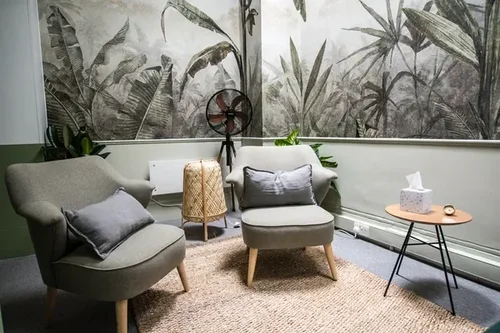
The Kensington room sits on the second floor of Kensington Counselling Rooms, a dedicated therapy space on Gloucester Road. It's an intimate, carefully considered room: warm lighting, a couch, comfortable seating, and a botanical mural that many clients find immediately calming. There are skylights rather than street-facing windows, which gives the space a natural sense of privacy that suits the work.
Who comes to this room.
Many of the couples seen here are dual-career professionals living in and around South Kensington, Chelsea, and Knightsbridge, and this practice also sees a strong international community drawn to the area's long-standing French, American, and Middle Eastern presence. What tends to bring couples in are the pressures that build when a relationship has to hold a lot at once: money, work, family expectation, infidelity, and the decisions that surround marriage.
Entrenched conflict
Arguments that recur in the same shape and escalate quickly, often because the real disagreement runs deeper than the topic on the surface.
Money
One of the most common and least openly discussed sources of tension; spending styles, earning gaps, family money, and mismatched expectations.
Infidelity & broken trust
Affairs, emotional affairs, and secrets that have come to light. The work afterwards is hard, and rarely something either partner can navigate alone.
Pre-marital questions
Couples who are engaged or planning a wedding and starting to notice unresolved questions underneath the logistics.
Diverging life direction
Children, moving, two careers, family of origin, an unhappy job; the big decisions that need to be made together.
Loss of closeness
Couples who still love each other but no longer feel close, or are unsure whether desire can return after years of routine.
The consultation and your first session.
These are your first two meetings with me. They're designed to be straightforward and to ease you in without pressure. The Kensington room is private and discreet. Sessions are scheduled to ensure minimal overlap with other clients, and the entrance is separate from the main building. If privacy matters to you, this space is built with that in mind.
The consultation is 30 minutes. I'll explain how I work and what to expect from therapy. You'll tell me what's brought you in and what you're hoping for. If you're comfortable, I'll take notes with your approval. Then I'll walk you through the practical side of things, including how booking works, costs, and what happens between sessions. There's no assessment, no pressure to commit to anything. It's a chance for us to see if working together feels right.
At the end of the consultation, we'll talk about how often you want to come. I usually recommend weekly sessions. Consistent weekly contact helps the work develop and means you're less likely to lose momentum. Ad-hoc slots can't be guaranteed week to week, so if you're hoping to come regularly, weekly is the more reliable option. If you're working through something very specific and focused, we can talk about what might work, but weekly tends to be the foundation I suggest.
If you want to proceed after the consultation, we'll book your first proper session. This is 50 minutes. We get to know each other. You'll each have space to say what's brought you in and what the relationship looks like from your perspective. I'm listening and understanding the dynamics. We're not trying to fix anything yet. You'll leave with a clearer picture of what you want from therapy and a sense of how we'll work together.
Fees.
Couples and relationship therapy sessions in Pimlico are £120 for 50 minutes on a weekly reserved slot, or £140 for ad hoc bookings.
Polycules (up to four people) are £160 per session on a weekly reserved slot.
Individual sessions are £80 on a weekly reserved slot, or £90 for ad hoc bookings.
A free 30-minute consultation comes before you commit to anything. If cost is a genuine barrier, get in touch and we can talk about it.