
By Mark Ryan, BACP Accredited Psychotherapist and NCPS Accredited Relationship Therapist, couples and relationship therapy in London
You fell in love again and brought your whole life with you. So did your partner. Now there are children with their own history, an ex partner somewhere in the background, and two adults who each assumed the other would see things the same way. Most days it feels as though every decision about the children is also a test of the relationship.
Blended family problems rarely mean the second marriage was a mistake. They usually mean two people are attempting something very hard without a map. In England and Wales alone, the 2021 Census counted 781,000 stepfamilies, and 547,000 of them included dependent children (Office for National Statistics, 2024). You are far from the only couple having these arguments at the kitchen table.
This article looks at what blended family life feels like, why the same conflicts keep coming back, what they do to a second marriage, and what helps. It applies whether you are the biological parent, the stepparent, or both, and whether you are married, engaged or simply living together with a combined set of children.
Article Summary
Most blended family problems come from two adults holding different views on what the children need, and from unclear roles, not from bad intentions.
Many parents lean in one of two directions. Some treat their own children as the main children, and others overcompensate with their stepchildren to make them feel welcome. Both can hurt the family.
Child rearing is the topic couples in second marriages argue about most, and how you discuss it matters more than whether you disagree.
Research suggests the biological parent usually does best as the main disciplinarian early on, while the stepparent backs the parent up and builds their own bond with each child.
The most useful starting point is the couple. Agree your relationship goals and your overall approach to parenting, then look at what each child needs, and bring the children into building the new family structure.
What blended family life feels like
If you are living this, you may be wondering whether it is normal to feel so stretched, so guilty, or so resentful. You may also be hiding some of those feelings because they seem unkind when children are involved. The experience looks different depending on where you sit in the family, so it helps to see it from each seat. Understanding what everyone else is carrying is often the first thing that softens the conflict.
If you are the biological parent, you are often caught in the middle. You want your partner to feel valued and you want your children to feel safe, and it can seem that every gain for one is a loss for the other. You may feel guilty about the divorce or separation, protective of your children, and tired of refereeing. Some parents end up silently choosing sides in every disagreement, which leaves everyone feeling worse.
If you are the stepparent, you may be doing a great deal of the day to day work without the standing that normally comes with it. You are asked to care about children who may not want you there, and to stay quiet about decisions that affect your own home. A Finnish study that asked stepfamily members and the professionals who work with them about everyday challenges found that professionals described stepparents feeling pushed to the sidelines of parenting, with unclear roles and role conflicts among the main difficulties (Pakarinen and Selänne, 2025). The study was small and recruited through snowball sampling, so it describes experience and does not measure how common it is.
Children have their own view. Most of the children in that study said they were doing fine with family life, which is worth hearing, but some said their opinions were not always listened to. Children often feel loyalty to a parent who lives elsewhere, grief for the family they had, and a sense that adults made major decisions about their lives without asking them. Many of them are watching closely to see whether the new adult is safe.
Why blended family problems keep coming up
Couples often tell themselves that the conflicts are about particular events, such as bedtimes, pocket money, or who took the children to the party. Those arguments are real, but they tend to sit on top of something deeper. Understanding what lies underneath helps you stop having the same argument in different clothes. It also helps you see your partner as someone facing the same problem from a different position, and not as the problem.
You disagree about what the children need
One of the most common patterns I see is that each parent holds a different view of what the children need in order to blend the family together. One partner may believe the children need space and time and should not be pushed into family dinners. The other may believe they need structure and togetherness from the start. Neither is wrong. Both are guesses made through the lens of their own childhood and their own children.
There is often a difference in the level of effort and support each parent thinks is necessary too. One person may be putting in enormous energy and feel unsupported. The other may feel they are doing everything they can and be baffled by the criticism. Without a shared picture of what good effort looks like, both people feel unseen.
Your own children become the main children, or the opposite happens
It is very human for a parent to see their biological children as their main children, because that is where the deepest bond and the longest history sit. When this goes unspoken, stepchildren can feel like guests and the stepparent can feel like an employee. The biological parent may not notice they are overriding the stepparent in small ways, or that their children get the benefit of the doubt that the stepchildren do not.
The reverse also happens. Some parents overcompensate with their stepchildren, trying so hard to make them feel welcome that they hold back from their own children, let rules slide, or put the stepchildren first. This can leave the biological children feeling displaced in their own home, and it often leaves the partner feeling criticised. Both patterns come from love and anxiety, and both tend to build resentment.
Roles are unclear and expectations are high
Blended families rarely come with an agreed script. Who disciplines, who comforts, who speaks to the school, and who has the final say on holidays are all questions that first families answer gradually, over years, with a baby who cannot argue back. In a stepfamily the same questions arrive at once, with older children who have opinions. A review of research on stepfamily couples noted that unrealistic expectations, including the belief that everyone will love each other quickly, are linked with more distress (Whitton, Nicholson and Markman, 2008). Love between a stepparent and stepchild tends to grow slowly, and often on the child's timetable.
Loyalty and the other household
A child who warms to a stepparent may feel disloyal to the parent who lives elsewhere. A parent who is friendly with an ex may make a new partner feel insecure. These loyalty pressures run through the whole system, including households you rarely see. A Japanese study of 421 young adults who had grown up with their mother and a stepfather found that two patterns were linked with worse outcomes. One involved an ambivalent bond with the father who lived elsewhere along with conflict between the parents. The other involved frequent conflict inside the stepfamily home. Both were associated with lower self esteem and higher depression, anxiety and aggression (Jikihara, Kikuchi and Nozawa, 2025). The study was retrospective and looked at one type of household in one country, so it shows links and does not prove cause. It does suggest that the tone between all the adults matters, not only the people under one roof.
How blended family problems affect a second marriage
Many second marriages begin with relief and the sense of finally getting it right. That makes it especially painful when the children become the main source of conflict. You may find that you stop being a couple and become a logistics team, and that the only conversations left are about schedules and behaviour. The loss of intimacy and fun is often the part people mention last, even though it can matter most.
Research backs up how central this is. A review of studies on couples in stepfamilies reported that child rearing is the topic remarried couples argue about most often. It also reported that satisfaction tends to decline faster in remarriages than in first marriages, with children brought into a remarriage linked to lower satisfaction (Whitton, Nicholson and Markman, 2008). The same review found that the way couples communicate about disagreements predicts how healthy the relationship is, more than the presence of disagreements. It also reported higher divorce risk in remarriages that involve children from earlier relationships, drawing on older research that was mostly American. Remarried couples were also described as more isolated than couples in first marriages, which means they often face this without a friend or family member who has been through it.
There is good news in the same body of work. The Finnish study found that stepcouples saw their relationship as the driving force of the stepfamily, even though they found it hard to maintain amid the demands of family life (Pakarinen and Selänne, 2025). If you hold the relationship as the foundation, a lot of the rest can be rebuilt. If it is neglected, every parenting disagreement lands on thin ice.
The patterns also echo what happens in many first marriages. A couple that cannot repair after conflict, that has stopped turning towards each other, or that never agreed how to parent, will struggle in either structure. If that sounds familiar, the articles on how to stop arguing with your partner and on repairing after a fight may help alongside this one.
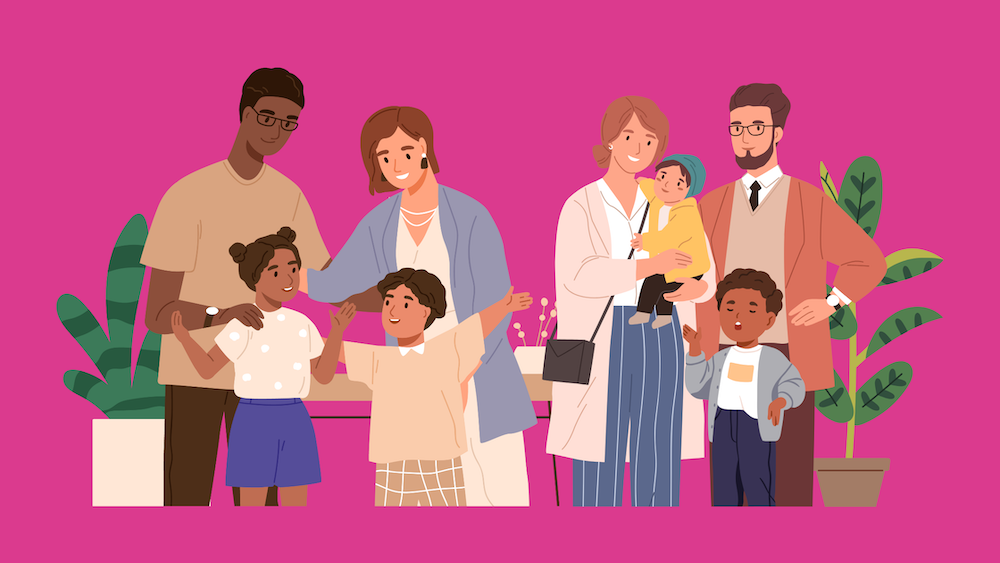
A new family structure is built slowly, with everyone having a say
What helps
When couples ask what to do about blended family problems, they often want a rule. The research and my own work both point towards a way of working more than a rule. It starts with the adults, moves to each child, and ends with the whole family building something together. Each of the sections below covers one step, beginning with the roles that tend to trip couples up.
If you are the biological parent
You hold the history, so the first job is to make your partner a real partner and not an observer. Talk to them about what you are worried about and what you need, before the next flashpoint. Tell your children, in plain language, that you love them and that this will not change, and that your partner is joining the family and not replacing anyone.
A systematic review of 37 studies on effective parenting in stepfamilies found that children and stepfamilies tend to do best when the biological parent remains the main disciplinarian, especially early on and with adolescents. They also do best when stepparents support the parent's decisions (Sanner, Ganong, Coleman and Berkley, 2022). That does not mean you decide everything alone. It means you hold the line with your children after the two of you have agreed what the line is. The same review found that children do not want to be go betweens carrying messages between adults, and that they prefer their parents to speak to each other directly.
Notice where you are favouring your own children without meaning to, or where you are overcompensating with your stepchildren out of guilt or fear. Neither is a failure. Both are signals that you are anxious about someone not feeling loved.
If you are the stepparent
You are allowed to want a place in the family, and you are also allowed to be patient. The same review listed supporting the stepparent and stepchild relationship among the things that work, and described stepparents as helping most when they back the biological parent’s decisions. Building a one to one bond with each child, in a way that suits the child and not the adult, is a natural way to do that (Sanner and colleagues, 2022). That might look like a shared interest, a regular small ritual, or simply being reliably calm.
It also helps to say out loud what you need from your partner. Many stepparents hold back because they fear sounding jealous of the children. A direct, kind request such as asking to be included in a decision, or asking for an evening alone together, is not a threat to the children. It is information your partner needs.
Together as a couple
This is where I focus most of my work. I ask couples to start by aligning with each other, before they try to align the children. That means agreeing what you want your relationship to be, and what your overall approach to parenting is. Where do you each stand on rules, routines, screens, money, and how much togetherness you expect? You do not need to agree on everything, but you need to know where you differ and have a way of deciding.
The next step is to look at what each of the children needs. This is a shift away from my children versus your children and towards a question that includes everyone. A shy eight year old and a sixteen year old who is stretching away from home need entirely different things from a stepparent and from family time. Treating them as individuals reduces the sense that the rules are aimed at one side.
From there, the aim is to create a new family structure that makes room for everyone, and not to force one family to fit inside another. Some traditions will be kept, some will be dropped, and some will be new. The last piece is to involve the children in building it. Children who feel they are part of designing the future, by choosing a Sunday ritual or helping decide how a shared room works, tend to feel less like observers of someone else's plan. The Finnish study noted that some children said their opinions were not always listened to (Pakarinen and Selänne, 2025), and asking is a simple way to change that.
Presenting a united front matters too. The review of effective stepfamily parenting linked a united front as a couple with less triangulation and closer stepparent and stepchild bonds (Sanner and colleagues, 2022). That means disagreeing in private, not in front of the children, and returning to the conversation later. It also means protecting time as a couple, with at least one regular slot that is not about the children.
Including the children
Children do not need adults to be perfect. They need to feel seen and not caught in the middle. Short, regular check ins that are about them and not about the family problem work better than big conversations. Ask each child separately what is going well and what they miss, and mean it when you say their view will count. If a child is struggling with loyalty to another household, make it clear that liking their stepparent does not betray anyone.
Blended families come in many shapes
Not every blended family looks the same, and the research tends to describe a narrow group. Many studies focus on a mother and stepfather and on mostly White, middle class samples, which the authors of the effective parenting review point out themselves (Sanner and colleagues, 2022). Your stepfamily may involve two mums or two dads, a nonbinary parent, partners who are not married, or children who move between several homes. The same questions about roles, loyalty and time apply to all of these.
Some families carry an extra layer. A recent US study of 24 adults whose parent had come out as LGBTQ after a divorce described two themes. Participants often felt torn in their loyalties, and in many cases they kept the relationship between their parent and stepparent hidden outside the family to protect against anticipated prejudice (Sanner, Goldberg and Allen, 2026). It was a small qualitative study of adult children, so it cannot tell us how common this is. It does remind us that a stepfamily can have to manage the outside world as well as its own relationships, and that children and adults in LGBTQ+ stepfamilies may need space to talk about that too.
How therapy can help with blended family problems
Many couples wait until the arguments feel unmanageable before they look for help, partly because they worry that needing support means the second marriage is failing. In my experience the opposite is closer to the truth. Couples who ask for help early tend to have a far easier time building something steady than those who wait for a crisis. A neutral space can lower the temperature and slow everything down.
Programmes designed specifically for stepfamily couples are usually educational and skills based. The review of this research suggested that the most useful content covers how stepfamilies work, how to communicate and handle conflict, how to parent and coparent with former partners, and how to build commitment. It also works well in groups with other stepfamily couples (Whitton, Nicholson and Markman, 2008). The authors also noted that the studies at that time were small, and that the field was still developing. Even so, those themes closely match what couples tell me they need.
In therapy, we usually begin with the two of you. We clarify what you each want from the relationship and from parenting, we look at how you talk to each other under pressure, and we work out what each child might need. From there we plan practical changes, such as who does what with discipline, how to handle handovers, and how to protect couple time. Individual sessions can help with something specific, such as guilt about the earlier separation or a hard relationship with an ex partner. If the family is in the middle of separation, you may also find the articles on co parenting after separation and telling the kids about separation useful, and the piece on how to separate or divorce well covers what comes before a new family forms.
If you are living with blended family problems and would like help moving from conflict to a shared plan, I offer a free 30 minute consultation, in person in London or online. It is a chance to talk through what is happening and to see whether working together would help. You can book using the button below.
Looking for something to work on between sessions, or before you decide on therapy? Our Resources page brings together a mix of free and paid resources for couples and individuals. You will find free guides to help you prepare for therapy, alongside paid workbooks on themes such as attachment, desire and intimacy, and ADHD in relationships. Each one is gently paced and designed to be used at home, on your own or together.
About the Author
Mark Ryan is a BACP Accredited Psychotherapist and NCPS Accredited Relationship Therapist based in London. He works with couples and individuals on relationship difficulties, family transitions, and the patterns that develop between partners under pressure. Read more about couples and relationship therapy in London.
References
Jikihara, Y., Kikuchi, M., & Nozawa, S. (2025). Stepfamily dynamics and emerging adults' adjustment in Japan. Four patterns affecting stepchildren's outcomes. Family Process, 64(4), e70071. https://doi.org/10.1111/famp.70071
Office for National Statistics. (2024). Children in families in England and Wales, Census 2021. https://www.ons.gov.uk/peoplepopulationandcommunity/birthsdeathsandmarriages/families/bulletins/childreninfamiliesinenglandandwales/census2021
Pakarinen, A. K., & Selänne, L. I. M. (2025). Perceived stepfamily challenges. A cross sectional descriptive study among stepfamilies and social and health care professionals. International Journal of Child, Youth and Family Studies, 16(1), 114 to 136. https://doi.org/10.18357/ijcyfs161202522401
Sanner, C., Ganong, L., Coleman, M., & Berkley, S. (2022). Effective parenting in stepfamilies. Empirical evidence of what works. Family Relations, 71(3), 884 to 899. https://doi.org/10.1111/fare.12703
Sanner, C., Goldberg, A. E., & Allen, K. R. (2026). Post divorce LGBTQ parent families. Navigating loyalty conflicts and stepfamily closeting. Journal of Marriage and Family, 88(4), 946 to 959. https://doi.org/10.1111/jomf.70071
Whitton, S. W., Nicholson, J. M., & Markman, H. J. (2008). Research on interventions for stepfamily couples. The state of the field. In J. Pryor (Ed.), The international handbook of stepfamilies. Policy and practice in legal, research, and clinical environments (pp. 455 to 484). Wiley. Author copy of the chapter
