
Divorce After 50: What the Research Says About Grey Divorce
By Mark Ryan, BACP Accredited Psychotherapist and NCPS Accredited Relationship Therapist
Separating after decades together is one of the hardest decisions a person can face. It often arrives with a sense that it is too late, too disruptive, or too selfish to consider. For the partner who did not see it coming, it can feel as though the ground has gone. This article looks at what research says about divorce after 50, often called ‘grey divorce’, and at what that evidence means for couples who are thinking about separating, who have decided to, or who have just been told it is over.
A note on language first. ‘Grey divorce’ is the phrase used in the research literature, and many people search for it, so it appears here. It is also a label taken from hair colour, and it says very little about the people it describes. A person of fifty-two and a person of seventy-eight are in very different positions, and neither has become a category. This article mostly says divorce after 50 or later life separation instead.
The evidence has clear limits, and they shape what can be said with confidence. Most of it comes from the United States, it concerns marriages rather than every kind of long relationship, and the studies discussed here are not designed to tell us much about same sex couples, unmarried couples, or people in other relationship structures. That does not mean the questions are absent for them. It means the research does not yet describe them well. Where UK evidence exists it is used, and where it does not, that is stated.
What the numbers do and do not show
In the United States, the divorce rate among people aged 50 and over doubled between 1990 and 2010, and by 2010 roughly one in four people getting divorced was aged 50 or older (Brown and Lin, 2012). That is the figure usually quoted. It is usually quoted without what came after.
A follow up study using data to 2019 found that the rate stopped rising for people aged 50 to 64 after 2010, and that the overall rate slipped slightly, although not by a statistically significant amount. For those aged 65 and over it has continued to climb. By 2019 about 36 per cent of people getting divorced in the United States were aged 50 or older, a figure that reflects the earlier rise, the ageing of the married population, and falling divorce among younger adults (Brown and Lin, 2022). The authors suggest the surge may be largely a Baby Boomer phenomenon, which would mean it eases as later generations age. They stress that they cannot draw firm conclusions.
The UK picture is harder to see. Office for National Statistics figures for England and Wales show that between 2004 and 2014 divorce rates fell in every age group for men, and for women under 55. Older groups saw much smaller falls than younger ones, and rates rose slightly for women aged 55 to 59 and stayed level for women aged 60 and over (Office for National Statistics, 2016). Divorce rates among older people held up far better than those among younger people, which is not the same as a surge.
There is also a more basic problem. Age at divorce was published until the 2019 data year, with high levels of missing information for 2014 to 2019, and from 2020 age was no longer collected during the divorce process (Office for National Statistics, divorce data). Divorce figures also count only legal marriages that end, so they miss long relationships between partners who never married. The claim that more couples in the UK are separating after 50 cannot currently be tested against official figures, and this article does not make it.
For anyone reading this in the middle of a decision, the practical meaning is simple. Divorce after 50 is common, so no one going through it is an outlier. It is also not an unstoppable wave, so no one needs to feel that it is inevitable either.
The usual explanations do not hold up well
Popular accounts of divorce after 50 tend to point to life events, such as an empty nest once children leave, retirement, or a health scare. These explanations are intuitive, and the researchers behind one major US study expected to find them. They tested all three directly, following couples over time. Contrary to those expectations, the onset of an empty nest, either partner's retirement, and either partner's chronic health conditions were unrelated to the likelihood of divorce (Lin, Brown, Wright and Hammersmith, 2018).
What did predict divorce looked much like what predicts it at any age. Couples who reported lower marital quality, had been married for a shorter time, held less wealth, and did not own their home were more likely to divorce. Roughly half of those who divorce after 50 are in a remarriage, and the divorce rate is two and a half times higher in remarriages than in first marriages (Brown and Lin, 2012).
None of this means an empty nest or retirement never matters to an individual couple. It means those events, on their own, did not stand out across a large sample. A more plausible reading is that the quality of the relationship matters more than the calendar, and that transitions are often the moments when long standing patterns become impossible to ignore. That reading is an interpretation rather than a finding, and the research cannot test it. The study measured chronic conditions, which is not the same as a sudden or severe illness, so its findings should not be stretched to cover that.
Attitudes have moved too. Research summarised by Brown and Lin (2022) found that the share of adults over 50 who accept divorce as a solution to an unsatisfactory marriage rose from just over half in 1994 to two thirds in 2012. Researchers also propose broader shifts, including a greater emphasis on personal fulfilment in marriage, women's growing financial independence, and longer lives. Those are proposed explanations rather than tested ones, since the available data cannot measure them directly.
What this can look like inside a relationship
Behind the statistics are relationships that have usually been changing for a long time. Interviews with divorced older adults, discussed by Brown and Lin (2022), identified growing apart in midlife as a common thread across couples. In long marriages and partnerships, life is often organised around shared projects such as children, work, and a home, and the relationship itself can become the least tended part. When those projects wind down, two people can find they know the routines of each other's days far better than each other's inner lives.
Loneliness inside a relationship is a common result, and it can go unspoken for years because nothing dramatic has happened. The relationship looks fine from outside, and each person assumes the other would not want to talk about it. A flat atmosphere, fewer shared interests, less physical affection, and a sense of living parallel lives are familiar ways it shows up.
In some couples, one person has been thinking about separating for far longer than the other. By the time the subject is raised, one partner may have spent months or years grieving the relationship privately, while the other hears it for the first time and is in shock. That gap in timing explains a good deal of the pain in the early stage, and it is not a sign of bad faith on either side.
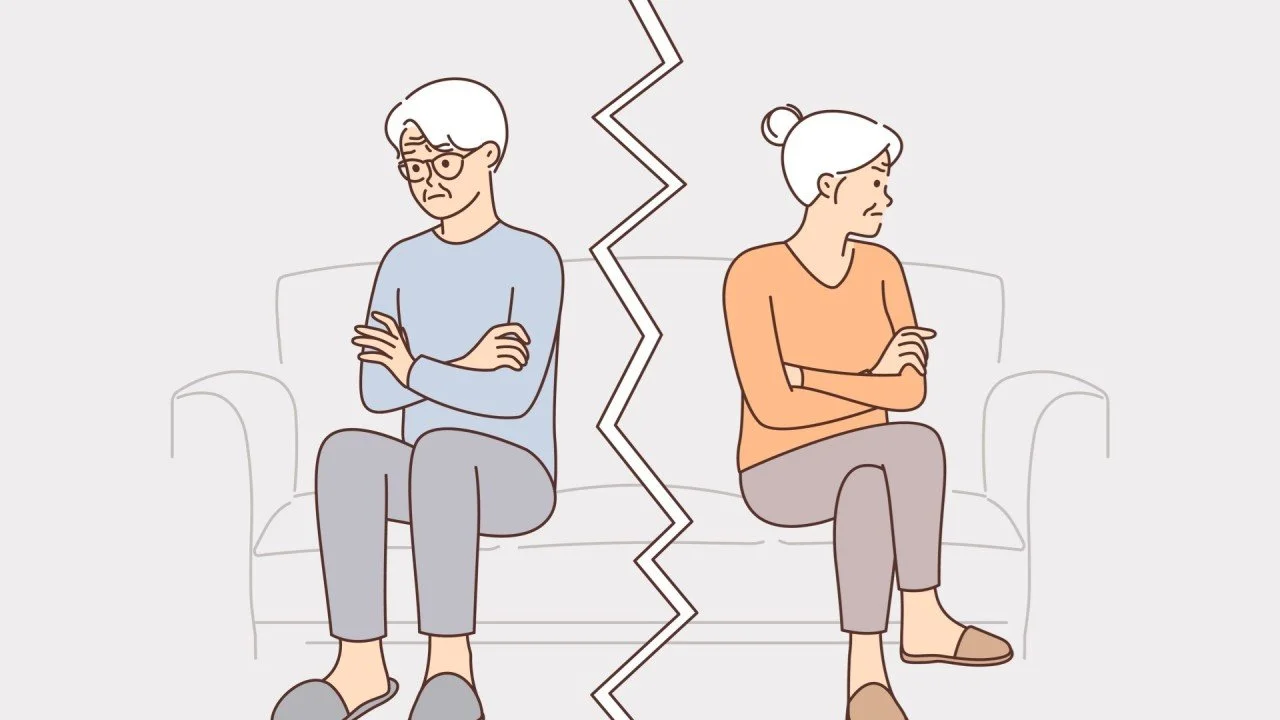
Roughly half of those who divorce after 50 are in a remarriage, and the divorce rate is two and a half times higher in remarriages than in first marriages
Deciding whether to separate
A decision this large is rarely settled in one conversation, and it does not have to be. It helps to separate two questions that tend to merge. The first is whether this relationship can become something that works for both people. The second is whether each person wants to find out. Couples can usually answer the first only after a real attempt at change, and a decision made out of exhaustion looks different from one made after that attempt.
A few questions can bring clarity. What would need to change for this relationship to feel liveable, and is that change realistic? What am I moving towards, rather than only away from? What would the next twenty years look like in each scenario? Each person may find it easier to answer these separately, in writing, before comparing notes.
Fear also needs to be separated from preference. Fear of being alone, of money, or of what family and friends will think are all legitimate considerations, and they are different from wanting to stay. Staying because of fear is a decision some people make with open eyes, and no one should call that a failure. The risk lies in not noticing that fear is what is deciding. The case for and against a trial separation is set out in a separate article for couples who are weighing that option.
The financial reality
Money is where the research is clearest, and most sobering. A US study followed people through divorce after 50 and found that women's standard of living fell by 45 per cent and men's by 21 per cent, while wealth fell by roughly half for both. For men the decline persisted over time. For women it reversed only on repartnering, and few people in the study formed a new shared household after divorce (Lin and Brown, 2021).
These are American figures, in a system with different rules on pensions, property, and support. They show the scale of what is at stake without predicting what would happen to any one couple in England or Wales. For many couples the home and pensions are among the largest assets they hold, and how they are treated depends on legal and financial detail that needs independent professional advice. This article cannot give legal or financial advice, and a therapist is not a substitute for either. Taking that advice early, before decisions are made in the heat of an argument, protects both people.
None of this is an argument for staying. Staying has costs that figures like these cannot capture, including years in a relationship that no longer works. The point is that the financial consequences are real, lasting, and easier to plan for when they are understood early.
How people fare afterwards
The emotional picture is more hopeful than the financial one. A UK study drew on nine waves of the UK Household Longitudinal Study and followed 909 adults aged 50 and over through marital break up. Depressive symptoms rose in the years before separation and at the point of separation. After separation they fell and returned to roughly their previous levels. Adjustment was faster for adults without children than for parents, and the study found no evidence that adjustment was slower for women than for men, or for people who had separated before (Tosi and van den Broek, 2020).
Two cautions apply. An average hides a wide range of individual experiences, and a return to baseline does not mean the separation was painless. What the study does suggest is that distress builds before a separation rather than only after it, in the long stretch of staying and deciding. Life after separation, with its practical and emotional adjustments, is covered in a separate article.
When one person has already decided
If a partner has said they want to separate, the early weeks often bring shock, bargaining, anger, and a search for explanations. The urge to work out who is to blame is understandable, and how blame works between partners helps explain why it so rarely settles anything. Taking time before making major decisions, finding support outside the relationship, and getting independent legal and financial advice are all reasonable first steps.
For the partner who has decided, the task is different. Saying it clearly and without cruelty, and accepting that the other person will need time to respond, matters more than finding the perfect moment. How to separate or divorce without destroying yourself or each other covers the practical side of doing this with care.
Separation after a long relationship involves more people than the couple. Adult children may take sides, or feel their own history is being rewritten. Grandparent roles, shared friends, family occasions, and a home that holds decades of memory all need thought. None of this has a standard answer, and it is easier to handle when each person is clear about what they are asking of the other, and of the wider family.
How therapy can help
Couples come to this at different points. Some are asking whether the relationship can be saved. Some have decided and want to separate with as little damage as possible. Some are far apart on what they want. Therapy can offer a structured place to say what has gone unsaid, to test whether change is possible, and to reach a decision, whichever way it goes, with both people clearer about what they want and why.
Where one partner wants to stay and the other wants to go, sessions cannot make the decision for either person, and a good therapist will not try to. What they can do is make sure the decision rests on a clear understanding of what each person feels, rather than on assumptions built up over years of silence.
For couples who have already decided, the work can focus on how to separate, including how to tell family, how to divide practical matters respectfully, and how to keep what was good about the shared history intact. For individuals, the period after a long relationship ends can bring grief, loneliness, and questions about identity that deserve their own attention. This work is open to couples and individuals of every gender and relationship structure.
If you feel like now might be the right time to talk this through with a therapist, I offer a free 30 minute consultation in person (in London) or online. Either partner is welcome to reach out first, whether you are considering separating, have already decided, or have just been told.
About the Author
Mark Ryan is a BACP Accredited Psychotherapist and NCPS Accredited Relationship Therapist working in person across central London, from rooms in Pimlico, Kensington, and Angel. He works with couples, individuals, and polycules on relationship issues including jealousy, affairs and betrayals, sex problems, and considered separation. His practice is integrative, sex positive, and affirming of all relationship structures and identities.
References
Brown, S. L., & Lin, I. F. (2012). The gray divorce revolution: Rising divorce among middle aged and older adults, 1990 to 2010. The Journals of Gerontology: Series B, 67(6), 731 to 741. https://doi.org/10.1093/geronb/gbs089
Brown, S. L., & Lin, I. F. (2022). The graying of divorce: A half century of change. The Journals of Gerontology: Series B, 77(9), 1710 to 1720. https://doi.org/10.1093/geronb/gbac057
Lin, I. F., & Brown, S. L. (2021). The economic consequences of gray divorce for women and men. The Journals of Gerontology: Series B, 76(10), 2073 to 2085. https://doi.org/10.1093/geronb/gbaa157
Lin, I. F., Brown, S. L., Wright, M. R., & Hammersmith, A. M. (2018). Antecedents of gray divorce: A life course perspective. The Journals of Gerontology: Series B, 73(6), 1022 to 1031. https://doi.org/10.1093/geronb/gbw164
Office for National Statistics. (n.d.). Divorce data in England and Wales. https://www.ons.gov.uk/aboutus/transparencyandgovernance/freedomofinformationfoi/divorcedatainenglandandwales
Office for National Statistics. (2016). Divorces in England and Wales: 2014 [Statistical bulletin]. https://www.ons.gov.uk/peoplepopulationandcommunity/birthsdeathsandmarriages/divorce/bulletins/divorcesinenglandandwales/2014
Tosi, M., & van den Broek, T. (2020). Gray divorce and mental health in the United Kingdom. Social Science & Medicine, 256, 113030. https://doi.org/10.1016/j.socscimed.2020.113030
