
By Mark Ryan, BACP Accredited Psychotherapist and NCPS Accredited Relationship Therapist
Most couples can cope with a difficult relative for an afternoon. What wears them down at Christmas is something else, the feeling that they are facing the day on opposite sides. One of you is at a table full of people you did not choose, and the person who is meant to be on your side seems to have gone missing. Or you are the one who knows your family well, and you can feel your partner bracing for the first remark.
If that sounds familiar, you are in very good company. Christmas puts two families, two sets of traditions and a lot of unspoken expectation into the same few days, and your relationship is the thing that has to hold all of it. This article looks at why that is so hard, why the problem is rarely the in laws themselves, and how to go into the season feeling like a team. It applies whichever family you are visiting and whoever your partner is, including when a family has been slow to accept your relationship.
Article Summary
Christmas with the in laws strains couples mainly through the feeling of not being on the same team, more than through the relatives themselves.
The most common pattern is a mismatch in alignment and support. One partner feels unbacked, and the other feels caught in the middle.
Both partners can be right about what happened and still hurt each other in how they respond.
Research on couples shows that coping with stress together is strongly linked to relationship satisfaction.
The most protective moves happen before you arrive. Agree your plan, your signals and who speaks to whom.
Looking after the conversation with their own family usually works best for each partner.
Talking it through afterwards protects the relationship.
What It Feels Like When You Are Not on the Same Team
The difficulty rarely arrives as a big event. It arrives as a series of small moments that add up. A comment about how you load the dishwasher. An old story that everyone laughs at except you. A question about when you are planning to have children, or why you are not married yet, or where you will be next year. The remark itself may be small, but what stings is the silence that follows, when your partner says nothing and you are left to handle it.
If you are the one outside the family, it can feel lonely in a way that is hard to explain. You are surrounded by people and still feel on your own, waiting for a glance or a touch that tells you someone has noticed. When nothing comes, the day starts to feel like a test you are failing alone.
If you are the one inside the family, it feels different and just as uncomfortable. You are trying to keep everyone comfortable, and you can feel your partner's mood from across the room. You may feel guilty, defensive or tired of being asked to referee. It is easy to snap, or to shrink the problem by saying "that's just how they are," which can make your partner feel dismissed.
Both positions are painful, and they feed each other. The more alone one of you feels, the more they pull away or push, and the more caught the other becomes. By the time you are in the car home, the conversation is no longer about the relatives. It is about whether you can rely on each other.
Why Families Pull Couples Apart at Christmas
There are reasons this happens so reliably at this time of year.
Old roles return. Many of us slip back into the child, the peacemaker, the favourite or the black sheep within minutes of walking through our family's door. Your partner may be seeing a version of you that you rarely show at home.
Two sets of traditions meet. Every family has its own way of doing Christmas, from what time you eat to who opens presents first, and each feels like the obvious way to the people who grew up with it.
Loyalty gets tested. Choosing whose house to visit, how long to stay and who to see first can feel like a verdict on whom you love more, even when it is only logistics.
Culture and expectation shape it. In some families and cultures, being close to extended family is a core part of what a couple does, and saying no to an invitation carries a lot of weight. In others, independence is the norm.
Not every family accepts the relationship. Some LGBTQ+ people, and some couples from different backgrounds or faiths, spend Christmas with relatives who have been cool or critical about their partner, and the strain of that falls on both of you.
Everyone is tired. Money, travel, children, drink and disrupted routines lower patience just when it is most needed.
Culture matters more than we often say. A study of 7,973 married people in 35 nations looked at how couples cope with stress together and how satisfied they are. The link between the two varied between countries, and in some countries it was stronger for men and in others stronger for women (Hilpert et al., 2016). The authors concluded that couples' coping behaviour is shaped by the cultural context they live in. In practice, that means there is no single correct way to do the in laws. What matters is that the two of you agree on one that works for you.
The Pattern I See Most Often
When couples get stuck over one partner's family at Christmas, it is usually about not being aligned, or not supporting each other. There is a lack of feeling on the same team. The details differ from couple to couple. The pattern does not.
It often looks like this. One partner expects to be protected and backed up in the moment, and feels exposed when that does not happen. The other partner has spent their life managing this family and has strategies that work for them, such as keeping quiet, laughing it off or changing the subject. To them, intervening would make things worse. To their partner, the quiet looks like abandonment. Both are trying to keep the peace, and each is protecting something different.
The disagreement then moves from the family to the couple. "You didn't say anything." "I was trying to keep things calm." "You always take their side." "I don't take anyone's side, I just can't stand a scene." These are not arguments about the in laws. They are arguments about whether you are in this together.
Research on couples supports how much this matters. A pooled analysis of 72 samples and 17,856 participants found a strong association between dyadic coping, meaning the ways partners cope with stress together, and relationship satisfaction (Falconier et al., 2015). Partners' perceptions of how the other copes, and of how the two of them cope together, were stronger predictors of satisfaction than perceptions of their own coping. Collaborative coping and supportive coping were among the stronger predictors. The way you handle stress as a pair, and how it feels to the other person, matters at least as much as what you do alone.
What your partner perceives is the key word. You may feel you were supportive, and your partner may not have felt it. A study of 472 people in romantic relationships found that those who felt their partner was more responsive to their needs showed less attachment anxiety and avoidance in that relationship (Rice et al., 2020). Feeling backed up changes how safe the relationship feels. That fits attachment research, which describes how a sense of security can be strengthened in adulthood through close relationships (Mikulincer and Shaver, 2020).
The shape of the argument matters too. In a study of 175 heterosexual couples, a pattern in which one partner withdrew while the other demanded or became aggressive was associated with lower relationship satisfaction for both people (Bretaña et al., 2021). After a hard visit, one of you may want to talk it through at once while the other needs quiet. If that becomes pursuit and retreat, the day's strain gets a second life at home. My articles on blame in relationships and conflict avoidance describe how these loops form.
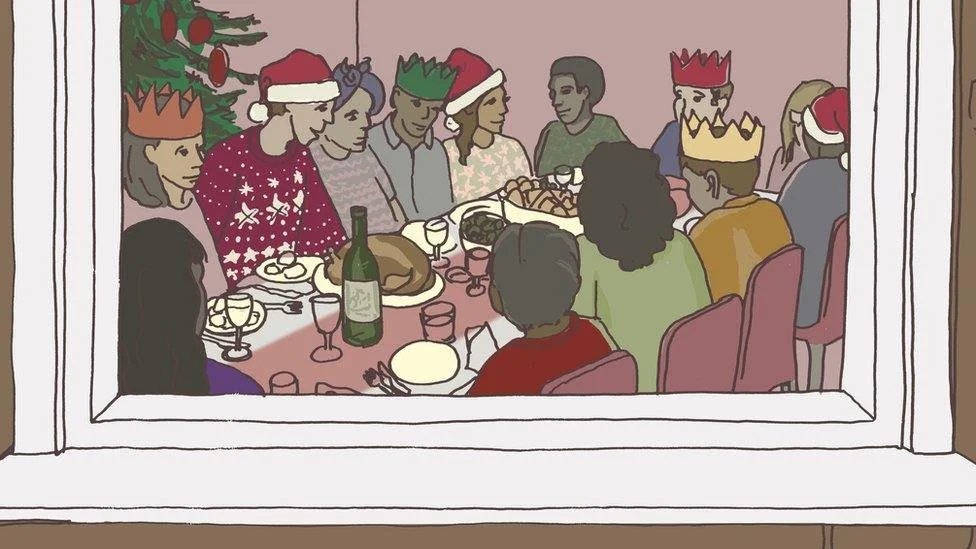
Christmas with the in laws strains couples mainly through the feeling of not being on the same team, more than through the relatives themselves.
What Helps Before You Go
Most of the useful work happens in the weeks before Christmas, when you are calm and not already in the room. The aim is to agree on how you will be a team, so you are not working it out under pressure.
Talk about the visit before it happens. Choose a time when neither of you is tired or already irritated, and keep it short. Ask each other what you are dreading and what would help.
Decide the plan together. Where you will be, for how long, who is cooking, where you will sleep and what you will say yes and no to. Make the decisions as a pair, then tell the families as a pair.
Say "we," not "I." When you tell relatives your plans, "we have decided" lands very differently from "my partner doesn't want to."
Agree who speaks to whom. Each of you usually does best managing communication with your own family, because you know the history and the tone. Your partner does not need to take on your mother, and you do not need to take on theirs.
Agree a signal. A word, a look or a hand on the arm that means "I need a break" or "I need you."
Agree an exit. Decide in advance how long you will stay and how you will leave without a scene. Knowing there is a way out makes the stay easier.
Share what you most need. For the partner who tends to stay quiet, it may be hearing "if someone says something that hurts you, I will say something." For the partner who steps in, it may be "I would like you to trust me to handle it my way."
My article on how to stop arguing with your partner has more on how to hold these conversations without them becoming a row.
What Helps During the Visit
Once you are there, the job is to stay connected, which is different from fixing things.
Check in with each other. A quick look across the room, or five minutes in the kitchen, tells your partner you have not forgotten them.
Back each other up in small ways. A short "I'll sit with you," or "we're going to head off at four," is often enough. You do not need to confront anyone.
Stay curious about your own family. The partner who grew up there often sees their relatives through habit. Try to notice what your partner is seeing and not explain it away.
Take breaks. A walk, an errand or a phone call can give you both room to settle.
Watch the drink. It rarely helps with tension, and it tends to lower the threshold for a row.
Keep your sense of humour for each other. A private joke or a shared look can turn a hard moment into something you went through together.
If a remark does hurt, you do not need to respond on the spot. You can simply say, "Can we step outside for a minute?" and sort it out between the two of you.
What Helps Afterwards
The debrief matters as much as the visit. It is easy to skip, because everyone is tired and relieved it is over. But the car journey home, or the first quiet evening, is often where the real damage or the real repair happens.
Start with what went well. Name one thing you appreciated about how your partner handled the day, even if it was small.
Say how it felt, not what they should have done. "I felt alone when your dad said that" is easier to hear than "you let him talk to me like that."
Listen for what they were trying to do. The partner who stayed quiet may have been trying to protect the peace. Hearing that does not mean you have to agree with it.
Agree one thing for next time. Pick a small change you can both manage, such as a signal or an earlier exit.
Let it end. If you have both said your piece, you do not have to keep going over it.
If the same argument keeps coming back after every visit, my articles on repairing after a fight and resentment in relationships may help. If you also find yourselves arguing about the whole season, my article on surviving Christmas without falling out covers the wider picture.
If you want a place to start the conversation about what each of you needs, my free needs and boundaries reflection takes you through it gently.
When It Is More Than Christmas
For some couples, the in laws are not a seasonal strain but a standing one. Perhaps one family is openly critical of your partner, or involved in decisions that should be yours, or there is a history of hurt that has never been addressed. When that is the case, Christmas simply brings it into view.
Some signs that it has become a larger issue include arguing about the same family member year after year, feeling that your partner does not put the relationship first, one of you dreading every contact, or the aftermath of each visit lasting for weeks. Those are signals about the relationship's wider pattern and not only about the holiday.
My article on why your partner may not listen to you looks at one part of how this plays out. If you are an LGBTQ+ couple dealing with a family that has not accepted you, the strain can be particularly sharp, and couples therapy for gay couples in London is something I offer. It is also worth knowing when to bring in help, and when to go to couples therapy sets out some of the signs.
How Therapy Can Help
Therapy helps because the problem is not the relatives, it is the space between the two of you. In sessions I work with couples to understand what each person needs when they are under pressure, and how to say it in a way the other can hear. We look at what each of you does when you feel exposed, and how to replace the pattern of pursuit and withdrawal with something that feels like being on the same side.
I work with couples of every background, including LGBTQ+ couples and couples from different cultures or faiths, and I do not assume that one way of doing family is the right one. You do not need to wait until January or until things have broken down. A few sessions before Christmas can give you a plan, a shared language and some steadiness for the visit. If your partner is not sure about therapy, my article on how to suggest couples therapy to your partner without a fight may help.
If you would like to talk it through, you are welcome to book a free 30 minute consultation, in person in London or online. It is a chance to describe what is happening and to see whether working together feels right. There is no obligation, and you do not need to have it worked out.
About the author
Mark Ryan is a BACP Accredited Psychotherapist and NCPS Accredited Relationship Therapist, and the founder of Rise and Grow Therapy, a private practice offering couples and relationship therapy across Kensington, Pimlico, and Angel, Islington in London, as well as online consultations. His approach draws first on Imago Relationship Therapy, alongside integrative relational, attachment based, Gottman, and systemic approaches. Mark works with couples of every background and relationship structure, as well as with individuals working through relational issues.
References
Bretaña, I., Alonso-Arbiol, I., Recio, P., & Molero, F. (2021). Avoidant attachment, withdrawal aggression conflict pattern, and relationship satisfaction: A mediational dyadic model. Frontiers in Psychology, 12, 794942. https://pmc.ncbi.nlm.nih.gov/articles/PMC8841843/
Falconier, M. K., Jackson, J. B., Hilpert, P., & Bodenmann, G. (2015). Dyadic coping and relationship satisfaction: A meta-analysis. Clinical Psychology Review, 42, 28 to 46. https://doi.org/10.1016/j.cpr.2015.07.002
Hilpert, P., Randall, A. K., Sorokowski, P., Atkins, D. C., & Sorokowska, A. (2016). The associations of dyadic coping and relationship satisfaction vary between and within nations: A 35-nation study. Frontiers in Psychology, 7, 1106. https://pmc.ncbi.nlm.nih.gov/articles/PMC4976670/
Mikulincer, M., & Shaver, P. R. (2020). Enhancing the broaden and build cycle of attachment security in adulthood. International Journal of Environmental Research and Public Health, 17(6), 2054. https://pmc.ncbi.nlm.nih.gov/articles/PMC7143531/
Rice, T. M., Kumashiro, M., & Arriaga, X. B. (2020). Mind the gap: Perceived partner responsiveness as a bridge between general and partner specific attachment security. International Journal of Environmental Research and Public Health, 17(19), 7178. https://pmc.ncbi.nlm.nih.gov/articles/PMC7578987/
