
By Mark Ryan, BACP Accredited Psychotherapist and NCPS Accredited Relationship Therapist
Some couples rarely argue. Friends describe them as easy going. Yet one or both of them carry a growing list of things they have decided not to say. The money worry, the comment at a family dinner, the sex that has stopped, the feeling of being taken for granted. It all gets swallowed because raising it feels like more trouble than it is worth. If that sounds familiar, or if you are the partner who keeps trying to raise things and keeps meeting a closed door, this article is for you. Avoidance is a pattern many long term couples describe. It makes sense once you see where it comes from, and it can often change when both people feel safe enough.
Article Summary
Conflict avoidance means steering around difficult topics, feelings or needs to keep the peace, and it can look calm from the outside while it feels lonely on the inside.
It shows up as changing the subject, saying "it's fine", staying busy and never talking about sex.
People usually avoid for good reasons, such as growing up around frightening rows, past attempts that went badly, or fear of hurting someone they love.
Studies of couples have linked holding emotions in with lower wellbeing and satisfaction, and found that partners tend to push for the change they want and pull back from the change their partner wants.
Small steps help most, including naming the fear, agreeing a pause with a return time, raising things gently and having a standing time to talk.
If you avoid because you are afraid of your partner's reaction, that is a safety question and not a communication problem, and support is available.
What Avoidance Can Feel Like
Many people who avoid conflict would never call themselves avoidant. They see themselves as the one who keeps things steady. You may be tired, with a long list in your head and a flicker of dread whenever your partner says "can we talk?". If so, you are not cold or a coward. You have found a way to protect something that matters to you, and it is probably costing more than it used to. A misconception I often push back on is that people who lean towards avoidance are unemotional, or that they are using power over when conversations happen. That is not how it usually feels from the inside.
From the inside, avoidance can feel like tension in the stomach before a difficult conversation, a speech rehearsed in the shower and never given, and relief when the topic passes. The relief rarely lasts, and flatness and resentment often follow.
On the other side of the table, it feels different. A partner who raises things and meets a shrug, a change of subject or a sudden need to check the post can begin to feel invisible. They may start to think they are asking for too much, or that their partner does not care. Some push harder, which brings more retreat. Some go quiet themselves. Both end up lonely in the same room.
How Avoidance Shows Up
Avoiding conflict is the form I see most often. Most of it is gentle and easy to miss, and these are the shapes it takes.
Changing the subject, or answering a serious question with a joke.
Saying "it's fine", "I don't mind" or "whatever you want" when it is not fine and you do mind.
Staying busy with work, children, the phone or the television so that there is never a quiet moment for a hard talk.
Never talking about sex, which in my experience is the second most common form after avoiding conflict. Closeness might open a conversation that feels too big. Nobody owes a partner sex, so low desire or saying no is not always avoidance.
Avoidance differs from taking a break. A break has a purpose and an end, such as "I am too angry to talk well, can we try again after dinner?". Avoidance has no return time, and the topic simply goes underground. The free Time Out Plan for Heated Arguments shows how to pause well. Avoidance also differs from the complete shutdown described in understanding stonewalling and emotional shutdowns, although the two can overlap.
Avoidance also differs from having given up. In my experience, giving up usually comes with emotional exhaustion and a sense of resignation. The person has lost hope that the relationship can change and no longer has the energy to try. Someone who is avoiding still cares and is still afraid, so the two ask for different responses.
Why People Avoid
Avoidance is a way of staying safe, and it is often learnt. Understanding where yours came from often softens it.
For many people it begins in childhood. If rows at home were loud, frightening or followed by days of silence, a child can learn that conflict is dangerous and that the best defence is to stay quiet. If feelings were mocked or ignored, a person can grow up believing that their needs are too much.
It can also be learnt inside the relationship. Perhaps early attempts to raise something ended in a bigger fight, or you tried several times and nothing changed. Many couples describe this, and people often say they stopped trying not because they stopped caring but because they ran out of hope.
Other reasons sit close to the surface.
Fear of hurting a partner who is already carrying a great deal.
Fear that honesty will open the door to something larger, even an ending.
Physical overwhelm, when the heart races, the mind blanks and going quiet feels like the only option.
A style of relating, often called avoidant attachment, in which closeness and emotional demands feel crowding. Avoidant attachment in relationships explores this in more depth.
None of these is a character flaw. Each is a reasonable response to something that once felt true.
How Avoidance Affects the Relationship
Keeping the peace seems like a gift to a relationship, and in the short term it often is. Over time, though, the things not said pile up.
Research on couples gives some clues, though it describes groups of people and cannot tell you what is true for the two of you. One study of dating couples looked at holding back feelings while making a sacrifice for a partner. In a 14 day diary study, days when people held back more were days when both partners reported lower emotional wellbeing and lower relationship quality. Three months later, holding back predicted a fall in relationship satisfaction and a rise in thoughts about breaking up. Feeling less authentic with a partner accounted statistically for these costs in the first two parts of the study (Impett et al., 2012). Not feeling able to be yourself with someone is a lonely place to be.
A second study watched 105 couples discuss a challenging topic once. Holding back emotion, meaning a gap between what people felt and what they showed, was common in both men and women and varied a great deal between individuals. Among the women, a bigger gap combined with a more rigid use of this approach went along with lower satisfaction in their own relationship, though not in their partners' (Dworkin et al., 2019).
Avoidance also rarely happens alone. An older study of 31 married couples found that both husbands and wives were more likely to press when discussing a change they wanted and more likely to pull back when it was their partner's. Men were more withdrawn overall in that sample, but the pattern also depended on whose change was being discussed (Christensen and Heavey, 1990). So in that study the roles shifted with the topic, and many couples describe doing both. In my experience this can become a loop, where the more one pushes, the more the other retreats. This describes couples who feel safe with each other, and the safety section below explains why it is different when fear is involved.
The quieter results may be familiar, and conversation can shrink to logistics, as in nothing left to say to each other.
Resentment builds and comes out sideways, as sarcasm, irritability or coldness, as the four communication styles that harm relationships shows.
Loneliness grows, as explored in why do I feel lonely in my relationship.
Desire fades, because it is hard to feel close to someone you cannot be honest with, as why desire fades in long term relationships explains.
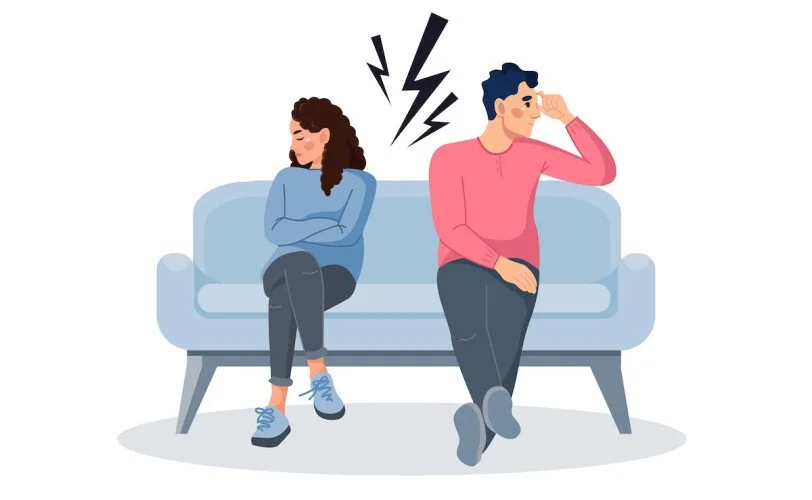
Keeping the peace seems like a gift to a relationship, and in the short term it often is. Over time, though, the things not said pile up.
Avoidance in LGBTQ+ and Non Monogamous Relationships
Avoidance is a human pattern and not a heterosexual one. In same sex relationships it can have an added layer, because many LGBTQ+ people describe learning early to keep parts of themselves quiet in order to stay safe. That skill can be a strength, but in a relationship two people who are both expert at not rocking the boat may find that nobody says what needs to be said. If this resonates, gay couples therapy in London describes the affirming way I work.
In consensually non monogamous relationships, I see avoidance most in two places. One is avoiding agreement on the principles of the relationship in any detail, so that each partner assumes the rules are the same. The other is not communicating breaches of an agreement. Both leave trust resting on guesses, and honest check ins matter as much here as anywhere. Jealousy in non monogamous relationships covers one common sticking point.
What Helps
Change usually starts smaller than people expect. You do not need to become a different person or have a grand conversation tonight. What helps is making honesty a little safer and a little more regular, so that the relationship learns that speaking up does not end in disaster. These ideas assume you feel safe with your partner. If you do not, please read the safety section below first.
If you tend to avoid, you might try the following. The first is what I most often say to people who avoid.
You can still avoid, or pull away, but you have to be the person who comes back to the conversation in a reasonable timeframe. You are allowed space, but you cannot keep deprioritising your partner's needs. "I need an hour, and then I would like to come back to this" tells your partner you are not disappearing.
Name what is happening in your body. "My chest goes tight when we talk about this" gives your partner something to respond to.
Say the fear out loud. "I go quiet because I am afraid of making it worse" is a vulnerable sentence, and many partners soften when they hear it.
If you are the partner who usually raises things, a few shifts can make a large difference.
Begin gently. Starting with "you never" tends to set off retreat, while starting with how you feel and what you need makes it easier to stay.
Bring one topic at a time, because a long list can feel like an ambush.
Notice when you chase. Following a partner from room to room usually deepens the retreat, and a calm "I will give you space and I would like to talk later" often works better.
Together, you can build habits that take the pressure off any single conversation.
Agree a regular time to talk, such as twenty minutes each week with a cup of tea. When talking is scheduled, nobody has to find the perfect moment.
Make repair a habit. A conversation that goes badly is not a failure if you return and say "that did not go the way I meant". Repairing after a fight offers a step by step guide.
Start the conversation about sex somewhere gentle. How to talk to your partner about sex is a good place to begin, and how to stop arguing with your partner has practical examples for conflict.
Sometimes people discover they have been avoiding the biggest conversation of all, which is whether they want to be in the relationship. If so, you are allowed to take that seriously. Nobody is obliged to stay in a relationship that no longer works for them. How to know when a relationship is over offers a way to think it through.
When Avoiding Is About Safety
Everything above assumes that both of you are safe enough to speak. Not every relationship is like that. If you stay quiet because you are afraid of how your partner will react, because you have been shouted at, belittled, threatened or hurt for speaking, that is not a communication habit. It is a response to a real threat, and it makes sense.
Signs include walking on eggshells, changing what you say to avoid the next row, being cut off from friends and family, being controlled over money, being pressured into sex, or being made to doubt your own memory. None of this is your fault, and couples therapy is not usually the right first step. Raising the abuse with your partner, or suggesting joint therapy, can increase the risk, so it is worth talking to a specialist helpline first, including about how to stay safe if you decide to leave. You can read more on coercive control versus conflict. Support is available.
The National Domestic Abuse Helpline is free and open 24 hours on 0808 2000 247, for women who are afraid of a partner. If you are a woman and are not sure, they will listen.
The National LGBT+ Domestic Abuse Helpline from Galop is on 0800 999 5428, and its opening hours are listed at galop.org.uk.
The Men's Advice Line is on 0808 8010327, from 10am to 5pm on weekdays, for men experiencing abuse from a partner.
If you are in immediate danger, call 999.
How Therapy Can Help
Good couples therapy is not an ambush and nobody is put on trial. A couples therapist will also keep an eye on safety, and may see partners separately first. The pace is steady.
In practice, the work often involves slowing the conversation down so that each of you can say what lies underneath the silence or the pushing. The partner who avoids can say what the fear is, and the partner who pursues can say what it is like to feel unreachable. Hearing this in a safe setting is often a turning point. When to go to couples therapy can help you decide if it is time, and you do not need to be in crisis. Individual therapy can also help the person who avoids understand where the pattern began.
I work with couples and individuals of all kinds, including same sex couples and those in consensually non monogamous relationships. If you would like help finding a way to speak and be heard, I offer a free 30 minute consultation, in person in London or online.
About the Author
Mark Ryan is a BACP Accredited Psychotherapist and NCPS Accredited Relationship Therapist, and the founder of Rise and Grow Therapy, a private practice offering couples and relationship therapy across Kensington, Pimlico, and Angel, Islington in London, as well as online consultations. His approach draws first on Imago Relationship Therapy, alongside integrative relational, attachment based, Gottman, and systemic approaches. Mark works with couples of all kinds, including LGBTQ+ couples and those in non traditional relationship structures such as consensual non monogamy, as well as with individuals working through relational issues.
References
Christensen, A., & Heavey, C. L. (1990). Gender and social structure in the demand/withdraw pattern of marital conflict. Journal of Personality and Social Psychology, 59(1), 73 to 81. https://doi.org/10.1037/0022-3514.59.1.73
Dworkin, J. D., Zimmerman, V., Waldinger, R. J., & Schulz, M. S. (2019). Capturing naturally occurring emotional suppression as it unfolds in couple interactions. Emotion, 19(7), 1224 to 1235. https://doi.org/10.1037/emo0000524
Impett, E. A., Kogan, A., English, T., John, O., Oveis, C., Gordon, A. M., & Keltner, D. (2012). Suppression sours sacrifice: Emotional and relational costs of suppressing emotions in romantic relationships. Personality and Social Psychology Bulletin, 38(6), 707 to 720. https://doi.org/10.1177/0146167212437249
