
Avoidant Attachment in Relationships: Dating, Hard Conversations, and Conflict
By Mark Ryan, BACP Accredited Psychotherapist and NCPS Accredited Relationship Therapist
I've written before about where attachment theory comes from and what the four adult styles broadly look like. This piece skips that ground and goes somewhere more specific, the three places avoidant attachment tends to show up and cause difficulty. In who you end up dating in the first place, in the harder conversations that come once you're together, and in outright conflict once things have properly settled in. Knowing the theory rarely changes anything on its own. What tends to help is recognising the pattern in the three moments it's most likely to be running the show.
One thing worth naming before any of that. There's been a sharp rise in casually labelling any distant, independent, or emotionally reserved partner or ex as avoidant, often with a harder edge to it than the word originally carried, closer to cold or incapable of love than to a specific, well-documented pattern with its own logic and its own pain attached. Someone who needs space after a long day, or who processes feelings more slowly than their partner, or who simply has a different baseline for how much closeness feels comfortable, can end up carrying a clinical-sounding label that implies something closer to a character flaw than an understandable adaptation. That flattening deserves its own proper treatment rather than a paragraph here, and it's something I'm planning to write about separately. For now, it's worth knowing that most of what follows describes a pattern that develops for understandable reasons and responds to the right kind of support, not a fixed character flaw, and that plenty of ordinary variation in how much space someone needs has nothing to do with the pattern this piece is describing.
In finding a partner
Avoidant attachment does some of its most consequential work before a relationship has properly started, and it works in a specific, almost counterintuitive direction. Research on how people respond to early romantic prospects has found something specific to avoidant attachment. Interest and expected reward both drop noticeably once a potential partner shows real signs of wanting closeness. That same drop doesn't happen with people who were never available in the first place, an ex, someone geographically distant, a situationship with a built-in ceiling (Spielmann, Maxwell, MacDonald and Baratta, 2013). Avoidant attachment doesn't lower interest across the board. It lowers interest specifically once real closeness becomes possible, which tends to be the exact moment someone starts to feel available and interested, and therefore the exact moment they become less appealing (not because anything has gone wrong, but because availability itself is what the system is built to move away from). In plain terms, the moment someone starts to feel available and interested tends to be the exact moment they become less appealing, not because anything has gone wrong, but because availability itself is what the system is built to move away from.
This produces a recognisable dating pattern. Someone avoidantly attached may find themselves consistently drawn to people who are somewhat unavailable, already partnered, living far away, emotionally guarded themselves, and consistently less drawn to people who are warm, consistent, and clearly interested. It's easy to read this as poor taste or bad luck. It's more accurately read as a nervous system that experiences the early stages of real availability as a mild threat rather than a reward, and adjusts its interest accordingly, usually without any conscious decision involved at all.
None of this means an avoidantly attached person can't want closeness, or won't eventually want it very much once a relationship is underway. It often means the wanting shows up differently, more as attachment deepens and the relationship has already proven itself somewhat safe, and less at the point most people expect it, the early rush of a new, promising connection. Recognising this pattern for what it is, rather than assuming disinterest at the exact moment interest is building underneath, tends to be one of the more useful early insights available.
There's a familiar shape to how this plays out repeatedly, too. A string of relationships that end just as things start asking for more, or a consistent pull toward partners who are themselves somewhat unavailable, isn't usually a coincidence or a run of bad choices. It tends to be the same underlying calibration, doing the same job it was built to do, across different people and different circumstances. That repetition is worth taking seriously as real information rather than dismissing as coincidence, particularly if the same relationship seems to end at roughly the same stage each time.
In difficult conversations
Once a relationship is established enough to involve real interdependence, a specific difficulty tends to surface, whichever of you is avoidantly attached ends up with disproportionate influence over which conversations happen at all. A large recent study following couples across several countries found that attachment avoidance is linked not just to how someone behaves in a hard conversation, but to whether their partner is able to raise concerns and be heard in the first place, avoidant withdrawal reliably limits a partner's ability to influence the relationship or have their concerns addressed (Körner, Overall, Chang, Hammond, Sasaki, Schütz and Zverling, 2025). Raising a need with a partner who reliably goes quiet, changes the subject, or leaves the room isn't just uncomfortable; it's structurally disempowering, and it tends to teach the other partner, over time, to stop raising things at all.
This isn't usually a deliberate power move, even though it can produce a power imbalance. For someone avoidantly attached, a conversation that asks for emotional disclosure, what do you need, where is this going, how are you feeling underneath all this, tends to register as a demand rather than an invitation, and the instinct is to create distance rather than lean in, precisely because leaning in is what feels unsafe. The result is a conversation that keeps getting deferred, shortened, or redirected toward something more practical, not because the topic doesn't matter, but because staying present in it is difficult in a way that's hard to explain to someone who doesn't share the pattern.
A related pattern is discomfort with a conversation that doesn't have a clear resolution or endpoint. Open-ended emotional check-ins, how are we doing, can we talk about us, tend to feel far more threatening than a conversation with a defined problem and a defined fix. This is part of why avoidantly attached partners sometimes seem far more capable in a crisis, where there's something concrete to solve, than in the quieter, more ambiguous conversations that ask for ongoing emotional presence instead.
This can create a frustrating mismatch for both people. The avoidant partner often experiences the practical, problem-solving version of themselves as their most genuine and helpful self, showing up, fixing things, being reliable in a crisis. The other partner often experiences that same practical mode as a way of avoiding the conversation, a retreat into logistics when what's being asked for is presence, a pattern that shows up under a different name in a lot of the feeling unheard I hear described in the room. Both readings are true at once, which is part of what makes this particular mismatch so hard to resolve without a third perspective in the room.
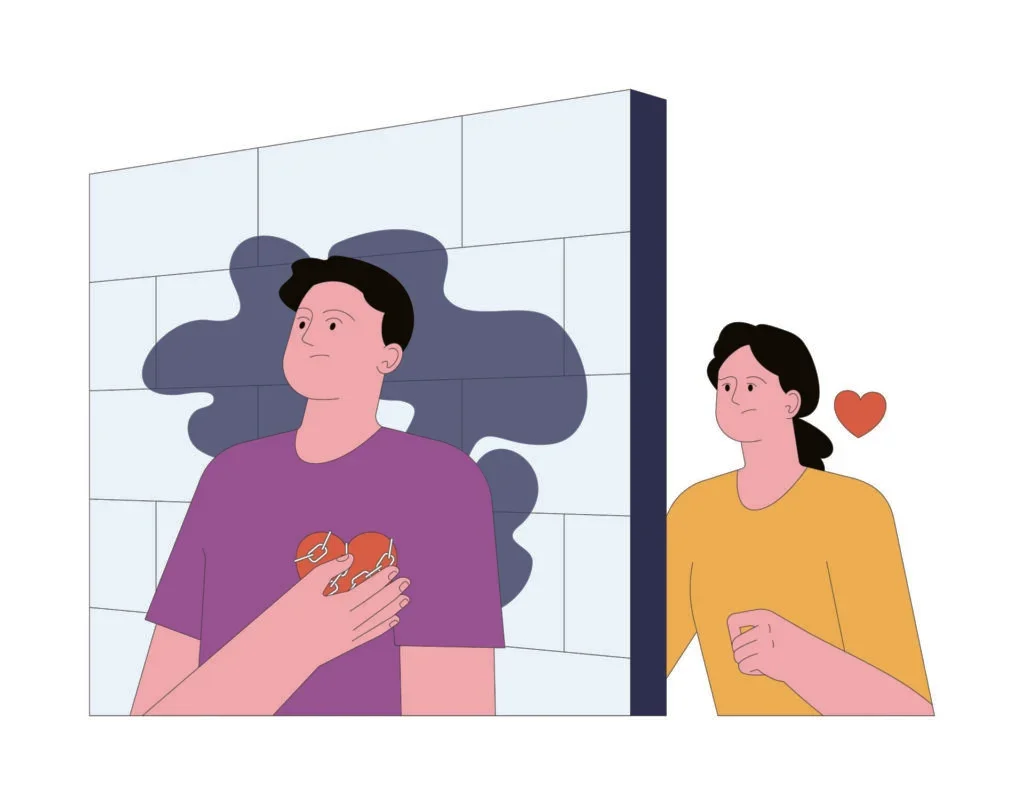
Often, the instinct is to create distance rather than lean in, precisely because leaning in is what feels unsafe
In conflict
Conflict is where the avoidant pattern becomes hardest to miss. A dyadic study of couples found that the avoidance dimension of attachment was strongly linked to withdrawal as a conflict strategy specifically, more so than to any aggressive or demanding response, and that this withdrawal predicted lower relationship satisfaction for the withdrawing partner as well as their partner (Bretaña, Alonso-Arbiol, Recio and Molero, 2022). Going quiet in an argument isn't a neutral pause for most avoidantly attached people. It's the primary strategy; the thing the system reaches for automatically once conflict starts to feel like too much.
This has a specific shape that's worth naming directly, and it's covered in more depth in what I've written about the communication patterns that do the most damage to relationships, where withdrawal shows up as the last and often most corrosive of the four. From the outside it can look like calm, indifference, or stubbornness. It's almost never any of those things. It's closer to a genuine sense of being flooded, a nervous system that has reached the edge of what it can process and has started to shut down rather than escalate.
The trouble is that withdrawal doesn't read as overwhelm to the partner on the receiving end. It tends to read as not caring, or as a refusal to engage, which understandably provokes more pursuit, more questions, more attempts to get a reaction, which in turn deepens the flooding and produces more withdrawal. Both partners end up correctly reading their own experience and incorrectly reading the other's, which is part of why this particular cycle is so difficult for a couple to interrupt without outside help.
It's also worth naming what avoidant withdrawal is not. It's rarely indifference to the relationship itself. People who don't care don't usually stay long enough to develop a reliable pattern of shutting down under pressure. The shutdown is a response to something mattering enough to feel dangerous, not evidence that it doesn't matter at all.
What a partner's response changes
How a partner responds to withdrawal is one of the strongest levers on whether the pattern eases or hardens over time. Pursuing harder, raising your voice, demanding immediate engagement, tends to confirm exactly what the avoidant nervous system feared about the conversation in the first place, and produces more withdrawal, not less. Partners who instead name the pattern calmly and offer a concrete pause with a real return time, I need twenty minutes and then I want to keep talking about this, tend to see the shutdown resolve faster and more completely than partners who either chase the withdrawal or go silent themselves in retaliation.
This isn't about a partner walking on eggshells indefinitely or absorbing all the relational labour so the avoidant partner never has to sit with discomfort. It's about understanding that a demand for immediate emotional presence, however reasonable the demand, is likely to produce the opposite of what it's asking for, and that a structured pause followed by a genuine return tends to get further than pressing harder in the moment.
What helps
The work here also splits into two things. One is individual, learning to notice the early signal of overwhelm before full shutdown sets in, a tightening, a pull to change the subject or leave the room, and building the capacity to name that signal out loud instead of acting on it silently. The other is relational, learning that closeness itself is not the threat it can feel like, which is slower and harder work than it sounds, since it usually means tolerating real discomfort rather than avoiding it.
This often means deliberately practising small moments of staying present rather than waiting for a crisis to force the issue. Sitting with a minor disagreement for slightly longer than feels comfortable, offering one more sentence of explanation than the instinct suggests is necessary, these small, repeated choices tend to do more over time than any single breakthrough conversation. The goal isn't to become someone who enjoys emotional intensity. It's to build enough capacity that ordinary closeness stops registering as a threat that needs managing.
Timing matters here too. Expecting to stay present through a hard conversation before you've built any tolerance for the discomfort involved tends to set the work up to fail. It usually starts smaller, noticing the urge to withdraw after the fact, then catching it while it's happening, then eventually being able to name it out loud in real time rather than acting on it. Each of those stages is real progress, even the ones that don't look like it from the outside.
How therapy can help
Some of this work happens individually, particularly building tolerance for the physical discomfort of staying present in a hard conversation rather than leaving it. Some of it happens with a partner in the room, since the pattern that keeps withdrawal locked in place is relational, one partner's pursuit and the other's retreat feeding each other, and untangling it usually needs both perspectives present at once.
You won't be asked to perform emotional openness you don't feel, and you won't be pushed to disclose faster than feels manageable. What I'm listening for is the specific moment things shut down, what happens just before it, and what would need to be different for you to stay in the room a little longer next time. Where a partner is involved, I'm also listening for their side, what the withdrawal looks like from where they're sitting, and what tends to turn their response into pursuit rather than patience. Neither side of that pattern is the villain of the story, and treating one partner as the problem and the other as the fix rarely holds up once both accounts are on the table together.
Where both partners are willing, this tends to move faster done together than either partner working on it in isolation. A partner who understands that withdrawal is overwhelm rather than indifference can offer the structured pause that helps, rather than the pursuit that makes things worse, and an avoidant partner who feels less chased often finds it easier to stay present for longer than they expected. Either way, the aim isn't to force someone to become a different kind of person, or to demand a level of constant emotional availability that isn't sustainable for anyone. It's to build enough tolerance for closeness that connection stops feeling like something to survive and starts feeling like something worth staying present for.
If you feel like now might be the right time to talk this through with a therapist, I offer a free 30-minute consultation in person (in London) or online.
About the Author
Mark Ryan is a BACP Accredited Psychotherapist and NCPS Accredited Relationship Therapist working in person across central London, from rooms in Pimlico, Kensington, and Angel. He works with couples, individuals, and polycules on relationship issues including jealousy, affairs and betrayals, sex problems, and considered separation. His practice is integrative, sex-positive, and affirming of all relationship structures and identities.
References
Spielmann, S. S., Maxwell, J. A., MacDonald, G., & Baratta, P. L. (2013). Don't get your hopes up: Avoidantly attached individuals perceive lower social reward when there is potential for intimacy. Personality and Social Psychology Bulletin, 39(2), 219–236. https://doi.org/10.1177/0146167212472541
Körner, R., Overall, N. C., Chang, V. T., Hammond, M. D., Sasaki, E., Schütz, A., & Zverling, E. (2025). The relational nature of attachment and power: Attachment avoidance and withdrawal limit partners' power. Personality and Social Psychology Bulletin. Advance online publication. https://doi.org/10.1177/01461672251333165
Bretaña, I., Alonso-Arbiol, I., Recio, P., & Molero, F. (2022). Avoidant attachment, withdrawal-aggression conflict pattern, and relationship satisfaction: A mediational dyadic model. Frontiers in Psychology, 12, 794942. https://doi.org/10.3389/fpsyg.2021.794942
