
Is My Ex Just Avoidant? What Social Media Gets Wrong
By Mark Ryan, BACP Accredited Psychotherapist and NCPS Accredited Relationship Therapist
I've written before about why labels like this one tend to get in the way of accountability rather than help it, and separately about what avoidant attachment looks like in dating, difficult conversations, and conflict. This piece sits between the two. It's about the specific version of avoidant that shows up when you're describing an ex, usually not as a clinical pattern but as a verdict, and what that particular use of the word tends to cost the person reaching for it.
Avoidant has become the internet's favourite villain
Search relationship content online and a pattern is hard to miss. Anxious attachment tends to get discussed with a fair amount of sympathy, framed as a wound, something someone is working through. Avoidant tends to get discussed as a character flaw, something closer to coldness or an inability to love properly. Researchers who study how attachment content spreads online have noted this asymmetry directly, avoidant partners are, in the words of one academic who studies adult relationships, much maligned, in a way anxious partners usually aren't, even though both patterns describe a similarly unconscious, similarly understandable adaptation to early experience.
The asymmetry runs deeper than tone. Anxious content tends to arrive with built-in permission to sympathise, framed around the anxious person's own suffering, their fear, their need. Avoidant content is usually written from the other side, framed around what it's like to date one rather than what it's like to be one. That single shift in perspective, whose experience the content centres, does a lot of quiet work in deciding who gets cast as the patient and who gets cast as the problem.
This matters because it shapes which version of avoidant gets amplified. Content that villainises travels further than content that explains, and a straightforward villain, cold, detached, incapable of commitment, is a much easier character to build an audience around than a person whose withdrawal is a fear response they didn't choose and don't fully control.
There's also a gendered pattern here, since it shapes how the label lands differently depending on who it's aimed at. Avoidant men get folded into a much older, more familiar cultural script, emotionally unavailable, commitment-phobic, that predates attachment theory entirely and slots the clinical term neatly into an existing stereotype. Avoidant women get less of that pre-built script to fall into, which sometimes means their withdrawal gets read as even more surprising or more damning, precisely because it doesn't match the story audiences already expect to hear.
The confusion baked into the word itself
Part of what makes avoidant such an easy label to misapply is that it covers two clinically distinct patterns, and online content rarely distinguishes between them. A dismissive-avoidant style is calm and consistent, distance that functions like relief, a steady preference for self-reliance over closeness. A fearful-avoidant style is much less stable, someone who wants closeness and fears it in roughly equal measure, moving toward a partner and then abruptly retreating, sometimes within the same conversation. These are meaningfully different experiences to be on the other end of, and they call for different responses, but online content usually collapses both into a single flattened idea of an avoidant ex, which fits neither pattern especially well.
This flattening has a practical cost beyond accuracy. Someone dealing with a partner's steady, dismissive distance is facing a different relational problem than someone dealing with a partner who oscillates between pulling close and pushing away. Advice built for one pattern, give them space, don't chase, doesn't translate cleanly to the other, where space can sometimes deepen the instability rather than settle it. A single, undifferentiated avoidant label tends to produce a single, undifferentiated piece of advice, applied to two situations that need different things.
A concrete version of this mismatch shows up constantly in how people describe an on-and-off relationship. An ex who broke up and got back together several times, alternating between intense reconnection and sudden distance, gets called avoidant just as often as an ex who withdrew steadily and never came back at all. These are close to opposite patterns underneath the same label. The first looks much more like the fearful-avoidant push-pull dynamic, and the second much more like a dismissive one, but both get filed under the same flattened word, which tells the next person reading about it almost nothing useful about what they'd be dealing with.
There's also a specific, well-documented behaviour that gets read as proof of avoidant coldness, disappearing from a relationship without explanation. A study examining attachment and ghosting found that people who had ghosted a partner reported meaningfully higher avoidance than people who hadn't (Powell, Freedman, Williams, Le and Green, 2021). The finding is real, but it's precise in a specific way. It links avoidance to a preference for indirect, low-conflict exits over confrontation, not to an absence of feeling. Silence, in this pattern, is usually the visible symptom of an internal aversion to conflict and exposure, not evidence that nothing was happening underneath it.
This distinction matters more than it might seem. Interpreted one way, silence confirms the villain narrative directly, they didn't care enough to explain themselves. Interpreted the other way, the same silence points to something closer to a skills gap, an inability to tolerate the discomfort of a direct, painful conversation, which is a very different thing to be frustrated by. Both readings can coexist with real hurt on the receiving end. Only one of them treats the other person as having chosen cruelty deliberately, and the research doesn't support that reading as the more common one.
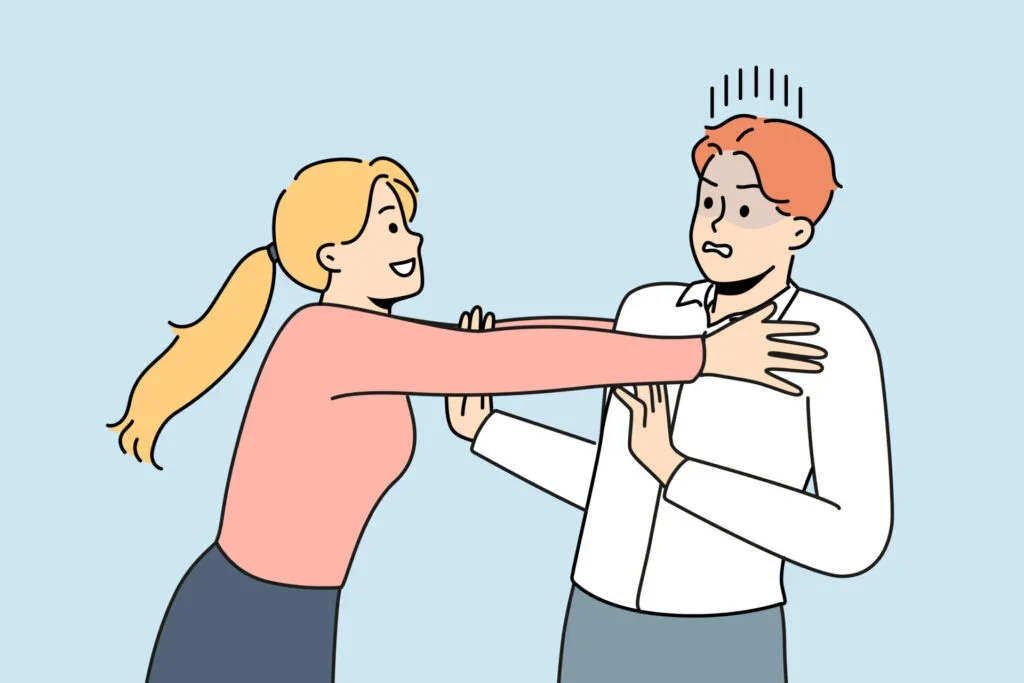
Anxious attachment tends to get discussed with a fair amount of sympathy, framed as a wound, something someone is working through. Avoidant tends to get discussed as a character flaw, something closer to coldness or an inability to love properly.
Why the label feels so satisfying to reach for
There's a real emotional logic to why avoidant lands so well after a relationship that ended in withdrawal or silence. Research on how people regulate lingering feelings for an ex has found that deliberately focusing on someone's negative qualities is a common and effective way of reducing residual attachment (Langeslag and Sanchez, 2018). Avoidant works particularly well for this specific kind of ending, because it turns an absence, someone pulling away, saying less, becoming harder to reach, into an explanation with a name attached, rather than a gap you're left to fill in yourself. A diagnosis feels more bearable than an unanswered question.
The same research found this strategy comes at a cost, though. Reducing love feelings this way tends to make people feel more unpleasant in the process, not less, even as the attachment itself fades. It's an effective way to stop missing someone. It isn't a reliable way to feel better, and the two are easy to confuse in the weeks after a relationship ends.
A particular version of this shows up often with avoidant specifically. The label can work almost too well as an explanation, because it locates the entire ending in the other person's fixed nature, they were incapable of closeness, rather than in anything that happened between the two of you. That completeness is part of the appeal. It's also part of the cost, since a relationship that ended for reasons involving both people, timing, communication, compatibility, gets simplified into a single-cause story that leaves less room to learn anything useful from it.
What the label costs you
Trait labels applied to other people tend to behave differently from labels applied to yourself. Research tracking how impressions of others change over time found that negative trait attributions become more fixed rather than less, resistant to being revised even by new information (Sanbonmatsu, Adams and White, 2022). Once an ex is filed as avoidant, that filing tends to hold. Later context, things you learn afterward, ways your own account of the relationship shifts with distance, tend to get absorbed into the existing frame rather than revising it.
There's a specific irony in this. If withdrawal under pressure is partly a response to feeling judged or cornered, and being publicly filed under a maligned online category is about as judged and cornered as it gets, then reaching for the avoidant label can end up producing more of the exact behaviour it's describing. Someone who senses they've already been decided about tends to have less reason to stay open, which can look, from the outside, like further proof the label was right all along.
It also tends to close down a question you'd otherwise ask honestly on your own side. Patterns in who we're drawn to and why relationships end up looking similar deserve to be understood on their own terms, and a tidy explanation about an ex's fixed nature tends to make that harder to see, not easier, since it locates the whole account in someone else's character rather than anywhere you might have agency to do something differently.
This applies with extra weight for people who've been drawn to a series of avoidant or dismissive partners specifically. If a pattern like this keeps recurring, the more useful question usually isn't which of your exes deserved the label most accurately. It's what's drawing you toward that dynamic in the first place, sometimes a familiar kind of unavailability that feels oddly like home, sometimes a preference for a partner who won't ask too much of you emotionally either. Neither of these possibilities is flattering to sit with, but they tend to be more useful than another confirmed diagnosis of someone who's no longer in the room to respond to it.
What to look at instead
Rather than reaching for the diagnostic term, it tends to be more useful to describe specifically what happened. Not he's avoidant, but he went quiet for three days after I brought up moving in together, and I didn't know how to read that. Not she's emotionally unavailable, but she changed the subject every time I asked what she wanted long-term. Specific behaviour holds up to scrutiny in a way a label doesn't, and it leaves room for a more accurate account, sometimes a genuine pattern of avoidance, sometimes a mismatch in pace or readiness, sometimes simple incompatibility that had nothing to do with either person's attachment history, and everything to do with two people wanting different things at different speeds.
This kind of account often reveals more than the single-word version could. A relationship where withdrawal showed up only around specific topics, commitment, family, the future, tells a different story than one where it showed up around everything, including ordinary daily closeness. The first often points to a specific fear about a specific kind of commitment, which is workable territory. The second points to something more pervasive, which needs a different, more patient kind of understanding. The label narcissist or avoidant collapses both into the same flat category. The specific account doesn't, and it gives you something to work with rather than just something to resent.
A useful question is what you wanted from the relationship that you didn't get, separately from what your ex's pattern was. Wanting more communication, more certainty, or more emotional availability than someone was able to offer isn't a diagnosis of them. It's information about a mismatch, and mismatches are common, ordinary, and survivable without either person needing to be filed under a fixed, unflattering category to explain them. Naming what you wanted, clearly and without blame attached, tends to be more useful going forward than any account of what your ex was.
How therapy can help
You don't need to arrive with a settled account of what your ex was, and I'd rather you didn't try to before we've talked. What's more useful is looking at the specific pattern between you, what you needed that wasn't available, what the withdrawal looked like in practice, and what you want to understand or do differently in whatever comes next. That work tends to move faster without a label doing the interpreting in advance, and faster still with someone in the room who has no investment in either version of the story.
Sometimes this work confirms that avoidance was a real, significant pattern, useful to understand properly not because it diagnoses an ex who's no longer in the room, but because it helps you recognise the pattern earlier next time and respond differently when it shows up again. Other times it surfaces something more circumstantial, a partner going through their own difficult period, a mismatch in readiness rather than a fixed trait, or a relationship that simply ended for ordinary reasons that had little to do with attachment at all. Both findings are useful. Neither one needs a diagnostic label attached to it before it can be taken seriously.
This is also part of a short series looking at how social media flattens clinical language into something closer to name-calling. If you've read this far wondering whether the label fits, the more useful question is usually what it's doing for you right now, whether it's helping you make sense of something painful, or just giving you a faster way to stop feeling it. Both are understandable reasons to reach for a word. Only one of them tends to leave you somewhere better six months on.
If you feel like now might be the right time to talk this through with a therapist, I offer a free 30-minute consultation in person (in London) or online.
About the Author
Mark Ryan is a BACP Accredited Psychotherapist and NCPS Accredited Relationship Therapist working in person across central London, from rooms in Pimlico, Kensington, and Angel. He works with couples, individuals, and polycules on relationship issues including jealousy, affairs and betrayals, sex problems, and considered separation. His practice is integrative, sex-positive, and affirming of all relationship structures and identities.
References
Powell, D. N., Freedman, G., Williams, K. D., Le, B., & Green, H. (2021). A multi-study examination of attachment and implicit theories of relationships in ghosting experiences. Journal of Social and Personal Relationships, 38(7), 2225–2248. https://doi.org/10.1177/02654075211009308
Langeslag, S. J. E., & Sanchez, M. E. (2018). Down-regulation of love feelings after a romantic break-up: Self-report and electrophysiological data. Journal of Experimental Psychology: General, 147(5), 720–733. https://doi.org/10.1037/xge0000360
Sanbonmatsu, D. M., Adams, T., & White, P. H. (2022). Perceived changes in trait attributions to others and the self. The Journal of Social Psychology, 164(5), 588–606. https://doi.org/10.1080/00224545.2022.2136060
