
Your First Couples Therapy Session in London: What Actually Happens
By Mark Ryan, BACP Accredited Psychotherapist (MBACP Accred) and NCPS Accredited Relationship Therapist
Most couples I see have spent weeks, sometimes months, deciding to come to therapy. By the time they arrive for their first session, they have usually played out a version of it in their heads several times. Some imagine something close to a courtroom, where one of them will be found at fault. Others imagine a quiet, awkward conversation that goes nowhere. A few have no expectations at all, just a hope that something will shift.
The reality of a first couples therapy session is different to all of these. It is more structured than people expect, and at the same time, more open. It is rarely as confronting as the catastrophic version, and rarely as inconclusive as the deflated one. What it is, more than anything, is the start of a conversation that begins to make sense of why things have become difficult, and what each of you wants to be different. If you are weighing up whether to take this step at all, the article Is Couples Therapy Worth It? What the Research Actually Says looks at the evidence for outcomes and may help you decide.
This article walks through what happens in a first session at Rise and Grow Therapy, a London-based private practice with rooms in Pimlico, Kensington, and Angel. It is written for couples who are considering therapy and want to know, in concrete terms, what they would be walking into.
Before the First Session: The Consultation
It is worth saying at the outset that the first therapy session is not the first contact. Before any couple begins therapy with me, we have a free 30-minute consultation, either in person, or online. The purpose of the consultation is not to start the work. It is to give you a clear sense of who I am, how I practise, and whether we are likely to be a good fit, before either of us commits to anything further.
During the consultation, I introduce myself and my approach, and I leave space for you to ask whatever feels useful. I then gather some basic intake information, the practical kind: safety considerations, accessibility needs, and a brief sense of why you are reaching out now and what you are hoping for, both from the therapy itself and from a therapist. We finish with the administrative pieces, the contract, fees, and how booking works.
By the time you arrive for your first proper session, the practical questions are out of the way. You know who you are meeting, where to go, and what the structure of the work looks like. The first session can then focus on what it should focus on, which is the two of you.
Arriving for the First Session
First sessions take place in person, at one of three London locations: Pimlico, Kensington, or Angel. Each room is private and quiet, set up specifically for therapy rather than borrowed from another professional context. There is no clinical signage, nothing that announces what you are there for. People come and go without anyone needing to notice.
The session itself is fifty minutes. You will sit on a sofa, and I will sit across from you. There is no clipboard, no fixed agenda I work through, and nothing you need to prepare in advance. If you have brought notes or things you want to make sure we cover, that is welcome, but it is not expected.
Most couples arrive a little nervous. That is entirely understandable, and I do not try to talk people out of it. The nervousness usually settles within the first ten or fifteen minutes, once the conversation has begun and the abstract idea of therapy has become a real, concrete experience.
The Three Opening Questions
There are three questions I tend to ask in a first session. They are simple on the surface and deliberately broad. They are designed to help me understand the relationship from the inside, rather than from a structured assessment looking in.
Tell me your story
This is almost always where I start. I want to know how the two of you met, how the relationship developed, and what has happened in it that feels significant. Not a chronological inventory, just the version of the story that comes naturally when you start to tell it. Often, one of you will start, and the other will fill in or correct as we go. The way you tell the story together is itself revealing. It tells me where the warmth is, where the hurt is, and what each of you carries as the central narrative of the relationship.
Some couples find this question easy. Others find it surprisingly hard, particularly if things have been strained for a long time and the story has become dominated by what is not working. Both responses are useful information.
What is your number one priority goal at the moment?
This question shifts us from the past to the present. I ask each of you separately, and I am genuinely curious about the difference between your answers, because there usually is one. One partner might say they want to stop arguing. The other might say they want to feel close again. These can sound similar, but they point to different underlying experiences and different routes through therapy.
The point of asking about a single priority is to slow down what often arrives as a tangled list of concerns. Couples in distress can feel as though everything needs to change at once, and that overwhelm itself becomes part of the difficulty. Identifying one priority does not mean ignoring the rest. It means having a clear place to start.
What is the main thing lacking for each of you in the relationship?
This question asks you to articulate something more emotionally specific. Not what is wrong, but what feels missing. The answers are often quieter and more vulnerable than the answers to the first two questions. People talk about not feeling seen. About not feeling wanted. About missing a kind of ease that used to be there. About feeling like a roommate rather than a partner.
What each of you names as missing tends to point toward what the relationship most needs to recover. It also tends to point toward what each of you has been quietly waiting for, often without saying so directly.
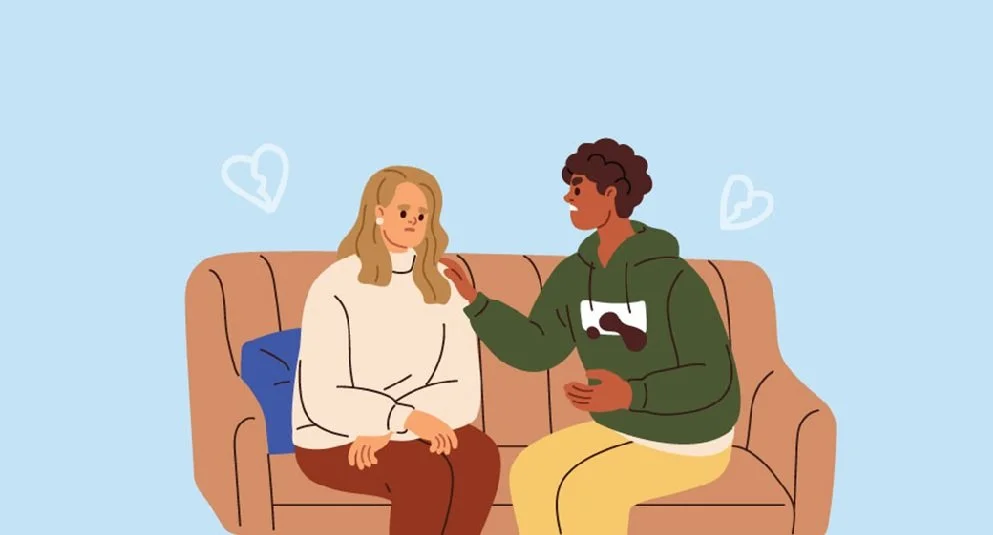
Most couples I see have spent weeks, sometimes months, deciding to come to therapy.
What I Am Listening For
While you are answering these questions, I am doing several things at once. I am taking in the content of what you are saying, of course, but I am also listening to how the two of you talk to each other, how you respond to one another's answers, and where the conversation feels easy versus where it tightens.
Research on couples therapy has consistently shown that the strength of the early therapeutic alliance, the sense that the therapist understands both partners and that the work can be done safely, is one of the strongest predictors of whether therapy will help (Flückiger et al., 2018). Establishing that alliance is much of what a first session is doing, even when it does not feel like a session is doing very much. In couples therapy specifically, the alliance has to be built with both partners, and the therapist's ability to maintain a balanced connection across the two has been shown to predict treatment progress (Knobloch-Fedders et al., 2007).
I am also beginning to form an early sense of the patterns at play in the relationship. The way couples respond to difficulty, particularly the dynamic between pursuing and withdrawing, or between voicing and shutting down, tends to show up quickly, even in a first conversation. I will not name these patterns at this stage, but I am beginning to see them. The article How to Stop Arguing with Your Partner: A Guide to Breaking the Cycle explores one of the most common patterns I see in first sessions and how it tends to be addressed.
What You Can Expect to Feel
First sessions are emotionally varied. Most couples leave feeling a mixture of relief, fatigue, and cautious hope. Relief because the conversation has finally been had, in a context where both of you were heard. Fatigue because the kind of attention required in a first session is unfamiliar and uses a particular kind of energy. Cautious hope because you have begun to glimpse a way forward, even if the work itself has barely started.
Some couples leave the first session having said things they had not said to each other before, or having heard something they had not heard. Others leave feeling the session was useful but that the real work is still to come. Both are normal. The first session is the start of the process, not a microcosm of it.
It is also worth saying that some couples leave the first session feeling worse before they feel better. Therapy can stir up what has been kept quiet, and that can be uncomfortable. This is not a sign that something has gone wrong. It is often a sign that the work has begun. If a difficult conversation does emerge in the days that follow, the article Repair After a Fight: A Step-by-Step Guide to Rebuilding Safety and Trust offers a practical way through it.
What Happens Next
At the end of the first session, we usually take a few minutes to step back and look at what has emerged. I will share my initial thinking about what I have heard, what seems important, and what I think therapy could usefully focus on. This is not a formal formulation; it is a working hypothesis we will refine together as the work develops.
Most couples I work with come weekly, particularly in the early phase. There is no fixed length to couples therapy, but it is usually helpful to think of the early phase as roughly six to eight sessions, after which we take stock of where things are and what is still useful.
If at the end of the first session it does not feel like the right fit, for either of you or for me, that is something we can talk about openly. Therapy works best when both partners feel they can do the work in the room with this particular therapist. If that is not the case, it is more useful to acknowledge it than to push on.
A Note on Couples Therapy Specifically
Couples therapy is structurally different from individual therapy in ways that matter for the first session. In individual therapy, the therapist works with one person's experience. In couples therapy, the therapist holds the relationship itself as the client. That means I am not on either of your sides. I am on the side of the relationship, which sometimes means saying things to one of you that the other has been wanting to say for years, and sometimes means gently challenging the partner who feels more obviously aggrieved.
This can feel unfamiliar at first. Most couples enter therapy hoping, on some level, that the therapist will see who is at fault. They rarely will. What they will do is help you both understand the patterns you are caught in together, and what each of you can do, separately and as a couple, to begin to shift them.
Common Practical Questions
Do we both need to be there?
Yes. Couples therapy requires both partners. If one of you is unsure, it can be useful to come for the consultation to see how it feels before committing. Individual therapy is a different kind of work and is not the same thing as couples therapy with one person present.
What if we are not sure we want to stay together?
That is one of the most common reasons couples come, and it is a legitimate place to start from. Therapy can help you reach a clearer answer to that question, whether that turns out to be staying together with a renewed understanding, or separating with more clarity and less harm.
What if one of us is much more nervous than the other?
That is normal and worth saying out loud at the start. The session will accommodate it. The more nervous partner does not need to lead, and the less nervous partner does not need to compensate. The pace is mine to manage, not yours.
If You Are Considering Booking
If you have read this far, you are probably already thinking seriously about therapy. The next step, if it feels right, is arrange a consultation. The consultation is genuinely free of pressure. Many couples have a consultation and decide to wait, or to think more, or to try a different approach first. Some go on to book. Either is a valid outcome, and the consultation is structured precisely so you can make that decision with better information.
Couples therapy will not fix everything in one session. But the first session, done well, can open up a conversation that has been stuck for a long time. That is what it is for, and it is often more than couples expect.
About the Author
Mark Ryan is a BACP Accredited Psychotherapist (MBACP Accred) and NCPS Accredited Relationship Therapist offering couples and relationship therapy in London. He works from rooms in Pimlico, Kensington, and Angel, supporting partners to understand the patterns they are caught in and rebuild a sense of connection that feels stable and meaningful.
References
Flückiger, C., Del Re, A. C., Wampold, B. E., & Horvath, A. O. (2018). The alliance in adult psychotherapy: A meta-analytic synthesis. Psychotherapy, 55(4), 316-340. https://pubmed.ncbi.nlm.nih.gov/29792475/
Knobloch-Fedders, L. M., Pinsof, W. M., & Mann, B. J. (2007). Therapeutic alliance and treatment progress in couple psychotherapy. Journal of Marital and Family Therapy, 33(2), 245-257. https://pubmed.ncbi.nlm.nih.gov/17437463/
