
Long Term Relationships After 60 and What Changes
By Mark Ryan, BACP Accredited Psychotherapist and NCPS Accredited Relationship Therapist
Somewhere around retirement, or after a health scare, or when the children and the careers have finally stopped taking up all the room, many couples look across the kitchen table and wonder who they are to each other now. Some feel a deep and settled closeness they would not swap for anything. Some feel a distance they do not know how to name. Many feel both on different days. Being together for decades does not mean a relationship stops asking things of you, and later life brings its own questions about time, bodies, roles and what you each want from the years ahead. This article looks at what tends to change after 60, why, and what helps.
Article Summary
Later life changes the shape of a relationship through retirement, caring roles, health, loss and shifting roles at home, and these changes are normal and workable.
Research on couples in later life points to something encouraging, including more affection when older couples resolve a disagreement and a protective effect of a satisfying marriage on day to day happiness.
Many people over 60 find intimacy in different ways, a sizable minority stay sexually active into their seventies and eighties, and how a couple talks about it matters alongside bodies and health.
Loneliness can sit inside a long relationship, and it deserves to be taken seriously.
Wanting different things from the years ahead is common, and it can lead to renewal or to a respectful separation. Both are legitimate.
What It Can Feel Like
Couples in later life describe a mix of things. Some feel a settled closeness, the ease of being known, the shared jokes and the history nobody else holds. Others feel they are living alongside a polite housemate, busy and a little lonely. Many feel both within a single week. Some are surprised by grief for the relationship they had when they were younger, or by a fresh restlessness.
If it feels as though something has shifted and nobody told you it would, nothing has gone wrong. Later life asks new questions, and a relationship that has lasted decades is allowed to need a conversation it has never had.
Why Later Life Changes a Relationship
For most of adult life, a relationship is held up by structure. Work, children, school runs, commutes, projects and a busy social calendar decide who is where, what needs doing and what you talk about over dinner. That structure does a surprising amount of the talking for a couple. When it falls away, through retirement, children leaving or illness, the relationship is left standing on its own, and two people find out what they have and have not said to each other over the years.
These are the changes couples most often bring to me.
Time together. When work stops, two people who used to meet in the evening may now share every hour of the day. Habits that were charming in small doses can start to grate, and one partner may long for space the other cannot imagine wanting.
Roles at home. Who cooks, who drives, who handles the money and who keeps the social life going often shifts. Roles that were never discussed can feel suddenly unfair, or suddenly empty.
Health. A diagnosis, a fall, a hospital stay or a slow decline changes the balance between partners. One may become the other's carer, and love and exhaustion can sit side by side.
Loss. Friends die, siblings fall ill, parents finally go. Grief and the awareness of time passing often sit in the background of a couple's conversations.
Hopes for the years ahead. One partner dreams of travelling, moving abroad or trying something new. The other wants to stay put and enjoy the home they built.
Time itself changes too. In my experience, as the years ahead begin to feel finite, many people become less willing to put up with distance and more hungry for warmth and honesty. That can bring a couple closer, and it can also bring to the surface things that were easier to leave alone when there seemed to be endless time. None of these changes is a verdict on the relationship. Each is a point where two people need to speak afresh, which is hard after decades of getting by on assumptions.
What Tends to Hold
It is easy to focus on losses at this age, so it helps to look at what research on couples in later life finds. It is encouraging.
One well known study observed 156 couples, some middle aged and some older, as they discussed a problem in their marriage. A coding system was used to identify the emotions they expressed. In the older couples, the resolution of conflict was less emotionally negative and more affectionate than in the middle aged marriages (Carstensen, Gottman and Levenson, 1995). The couples were husbands and wives, so we should not assume the same pattern for every kind of partnership. Even so, it matches what many couples tell me, that after decades together there is often less need to win and more appetite for tenderness.
A second study followed 47 older couples over eight days. Poorer perceived health on a given day was linked to a decline in happiness, but for both men and women, a satisfying marriage buffered that link. Spending time with other people did not have the same protective effect (Waldinger and Schulz, 2010). That fits what I see. A relationship in which each person feels known and on the same side does not remove pain, but it seems to cushion it.
What tends to hold is the thing that is hard to measure and easy to take for granted, the ease of being known, the shared history and the small rituals of affection. Naming these out loud often shows how much is still there.
Sex and Intimacy in Later Life
Many people over 60 wonder whether they are too interested or not interested enough, and it can be hard to say so.
A large English study of 6,201 people aged 50 to over 90 found that the proportion reporting any sexual activity in the past year declined with age, but that a sizable minority of men and women remained sexually active into their seventies and eighties. Poorer health was linked to less sexual activity and more difficulty with sexual functioning, particularly for men. Problems with sexual functioning were fairly common, yet concerns about sexual health were much lower overall. Disagreements between partners about who initiates, or feeling obliged to have sex, were linked to more dissatisfaction (Lee et al., 2016).
Sex does not simply switch off at a particular birthday. Physical difficulties are common and do not always bring distress. The findings suggest that how people feel about their sex life depends on the relationship as well as the body, including whether they can talk about it without pressure. Why desire fades in long term relationships explains patterns that show up at any age, and is our sex life normal helps you sort worry from fact.
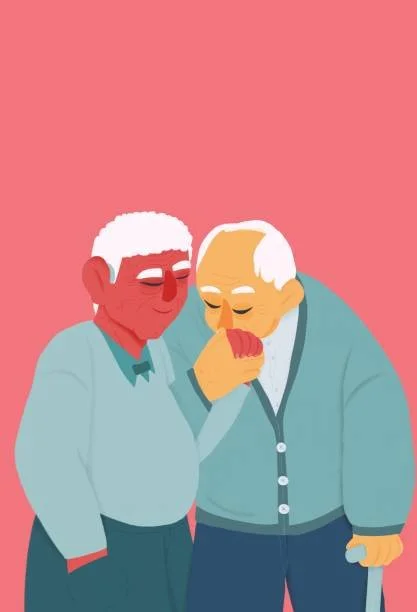
As the years ahead begin to feel finite, many people become less willing to put up with distance and more hungry for warmth and honesty
Loneliness Inside a Long Relationship
Loneliness is often assumed to belong to people who live alone, but many people in long relationships feel it too, and feel ashamed of it. It may arrive when a partner is unwell or withdrawn, when conversation has shrunk to logistics, or when you carry grief or fear that you cannot share.
If this sounds familiar, you are not being ungrateful. It is a sign that something in the connection needs attention. Why do I feel lonely in my relationship looks at what lies behind it, and nothing left to say to each other offers ways to start talking again.
Illness, Caring and Grief
Many couples in their sixties and beyond are living with illness or its shadow, whether their own or someone else's. Becoming a carer for a spouse changes a relationship, and so does being cared for. The carer can feel unseen and worn out. The person being cared for can feel like a burden and grieve the independence they had. These feelings are normal and they rarely get said.
Grief deserves its own mention. Two people can grieve very differently, one by talking and the other by doing. Neither is wrong, but without words for it, each can read the other's way of coping as coldness or as collapse.
LGBTQ+ Older Adults and Other Relationship Shapes
Many LGBTQ+ people now in their sixties and beyond lived through decades when their relationships were hidden, openly condemned or, for some, illegal. Some concealed a partner for years, or married and came out late. Many built chosen family, a network of friends who became the people they could depend on, because their families of origin did not always welcome them.
That history can shape later life in particular ways. Some couples carry a deep trust forged through years of facing the world together. Some carry old fears of being seen, or worries about care homes and hospitals where they may not feel safe being open. If any of this is part of your story, gay couples therapy in London and lesbian couples therapy describe the affirming approach I take.
Some couples in later life are also consensually non monogamous, whether they have been for many years or have only recently opened their relationship. The same themes of health, time, desire and trust apply, with additional layers about how partners support each other through illness and who is involved in care. Honest agreements and regular check ins matter as much at 65 as at 35. Opening a relationship covers what to think through.
When You Want Different Things From the Years Ahead
Sometimes the central issue is not distance or drift but direction. One partner wants to sell the house and travel, and the other wants to put down deeper roots. One wants more sex and affection, and the other wants less. One wants to end the relationship, or has wanted to for years, and is only now ready to say it.
These conversations can feel especially weighty later in life, when time seems shorter and the shared history is long. It helps to hold two ideas together. A long relationship deserves care and honesty, and nobody is obliged to stay in a relationship that has stopped working for them. Wanting more from the years you have left is not selfish. Courage in either direction, to renew the relationship or to leave it kindly, deserves respect.
If you are not sure which way you are leaning, how to know when a relationship is over offers a way to think it through. If you have decided to part, how to separate or divorce well covers doing so with dignity, and life after separation looks at starting again. Later life can hold new friendships, new interests and sometimes new love.
What Helps
Whichever way you are leaning, start by saying where you each are. Ask what you are looking forward to, what worries you, and what you would like more of.
Talk about time and space. If you are the one who wants more time apart, say it as a need of your own and not as a complaint about your partner, for example "I would love Tuesday afternoons to myself, and then I would love to cook for us both". If you are the one who fears that space means rejection, say that too. Agree what a good week looks like, which days together, which apart, and what each of you needs in order to feel like yourselves. A friendly conversation about who does what often releases years of unspoken resentment, and something to look forward to, such as a weekly walk or a regular lunch out, gives the week a shape.
Widen what counts as intimacy. Touch, kissing, massage, lying close, laughing in bed and being naked together are all intimacy. When one kind of sex becomes difficult, couples who stay curious often find other kinds of closeness that matter just as much. If one of you feels obliged and the other feels rejected, you are both often hurting, and saying so gently is kinder than silent avoidance. Our guide, 13 Golden Rules for Talking About Intimacy and Desire, is a gentle way in, and how to talk to your partner about sex goes into more detail.
If you feel lonely inside the relationship, small things often help first. Ask a question you have not asked in years, or share one thing that frightened you this week. Tell your partner one specific thing you value about them, because being known is one of the great comforts of a long relationship.
If you are caring for your partner, name what is true. "I am tired and I still love you" is a sentence that holds both. If you are the one being cared for, tell your partner what you can still give, and what you grieve, so that gratitude does not turn into silence. Outside support from family, friends, community services or a therapist means the relationship is not carrying the whole weight alone. When it comes to grief, say what you need, whether company, silence or practical help, because it saves a lot of misunderstanding.
Finally, notice repair. If a conversation goes badly, a warm word afterwards matters, and repair after a fight has simple steps. If a hard topic keeps getting avoided, name it gently with "there is something I would like us to talk about, and I would like to do it kindly".
How Therapy Can Help
In my experience, couples in their sixties, seventies and eighties often bring patience and a willingness to reflect, which makes the work rewarding.
Therapy gives you a steady, confidential space to say what has been hard to say. It can help you hear each other beneath old arguments, understand how your patterns have developed, and take stock of what matters now. It can support a couple through retirement, illness, loss, a difficult conversation about sex, or a decision about whether to stay or to part. Individuals in a couple can use it on their own too, to sort out their feelings before deciding what to say. If you are wondering whether now is the time, when to go to couples therapy can help you decide. You do not need to be in crisis. Many couples come simply because they want the next chapter to be better than the last.
If you and your partner are adjusting to a new stage, or you are on your own and wondering what you want from your relationship, I offer a free 30 minute consultation, in person in London or online. It is open to individuals and couples of all kinds, including LGBTQ+ people and those in consensually non monogamous relationships.
About the Author
Mark Ryan is a BACP Accredited Psychotherapist and NCPS Accredited Relationship Therapist, and the founder of Rise and Grow Therapy, a private practice offering couples and relationship therapy across Kensington, Pimlico, and Angel, Islington in London, as well as online consultations. His approach draws first on Imago Relationship Therapy, alongside integrative relational, attachment based, Gottman, and systemic approaches. Mark works with couples of all kinds, including LGBTQ+ couples and those in non traditional relationship structures such as consensual non monogamy, as well as with individuals working through relational issues.
References
Carstensen, L. L., Gottman, J. M., & Levenson, R. W. (1995). Emotional behavior in long term marriage. Psychology and Aging, 10(1), 140 to 149. https://doi.org/10.1037/0882-7974.10.1.140
Lee, D. M., Nazroo, J., O'Connor, D. B., Blake, M., & Pendleton, N. (2016). Sexual health and well being among older men and women in England. Findings from the English Longitudinal Study of Ageing. Archives of Sexual Behavior, 45(1), 133 to 144. https://doi.org/10.1007/s10508-014-0465-1
Waldinger, R. J., & Schulz, M. S. (2010). What's love got to do with it? Social functioning, perceived health, and daily happiness in married octogenarians. Psychology and Aging, 25(2), 422 to 431. https://doi.org/10.1037/a0019087
