
By Mark Ryan, BACP Accredited Psychotherapist and NCPS Accredited Relationship Therapist, individual therapy in London
Maybe your partner will not come to couples therapy, or you are not ready to ask. Maybe you want to understand yourself before you decide what to do. Whatever the reason, you are wondering whether it is worth going alone when the problem sits between two people. It is a fair question, and it deserves a clear answer.
The short answer is yes, individual therapy can help with relationship problems. It cannot change your partner, and it does not replace couples therapy when a pattern needs both of you in the room. What it can do is change your side of the dynamic, and that tends to change the dynamic itself. This article explains how that works, what it can and cannot do, and how to decide whether to start.
Article Summary
Yes, individual therapy can help with relationship problems. It works on your side of the pattern and on the history that shapes how you respond.
It takes two people to create a dynamic, and it can shift when one person changes how they take part.
People who come on their own often learn about their own part in the dynamic and gain perspective on the patterns they are caught in.
Deeper rooted challenges and historic issues often need more space than couples sessions allow, and they affect the relationship deeply.
Research on individual therapy and relationship satisfaction is still thin, and what exists points to modest gains.
Individual therapy cannot change your partner, and couples therapy usually suits patterns that need both of you present.
If you are afraid of your partner, specialist support comes first.
What It Feels Like When You Are the One Reaching for Help
Reaching out alone can feel lopsided. You may have asked your partner to come, heard no or not now, and been left carrying the whole problem. Or you may not have asked at all, either because you suspect the answer or because you are not yet sure what you want. Either way, there is often a worry that you are being unfair, as though working on yourself means admitting the problem is all yours.
That worry is understandable, and it rests on a mistaken idea. Going to therapy alone does not mean the relationship is your fault. It means you are choosing to work with the one part of the situation you can influence, which is you. Many people also come alone for the opposite reason. They are tired of going round the same argument and want to understand why it keeps pulling them in.
Some people arrive unsure whether they want to stay. Others want to stay and cannot see how. Both are welcome, and neither needs to have an answer before the first session. If your partner is reluctant, my article on what to do when your partner won't go to couples therapy covers that situation in more depth.
Why One Person Can Change a Dynamic
The belief that you cannot fix a relationship alone is half right. A dynamic is made by two people, and you cannot control the other person's part. But a dynamic is also a loop. What you do shapes what your partner does next, which shapes what you do after that. If one of you changes your side of the loop, the loop has to change too, even if the other person does not set out to change at all.
It takes two to create a dynamic, but only one person to change it. That is not a promise that the relationship will improve. It describes where the leverage is, and it is the reason individual therapy can matter even when the relationship is the problem.
Research on couples shows how closely the two sides are linked. In a 2021 study of 175 heterosexual couples, a pattern in which one partner withdrew while the other demanded or became aggressive in conflict was associated with lower relationship satisfaction for both people (Bretaña et al., 2021). Avoidance in one partner was also linked to lower satisfaction for both, and it was tied to that person's own withdrawal during conflict. The study looked at heterosexual couples, so it describes that group. The central point is that the pattern belonged to the pairing and not to either person alone.
The same logic applies in a relationship with more than two people. A pattern there belongs to everyone involved, and any one person who changes how they take part changes what the others have to respond to.
So what changes when one person changes? Someone who learns to stay present instead of withdrawing gives their partner less to chase. Someone who learns to ask for what they need without accusation gives their partner less to defend against. The partner may not notice at first, and may even push back, because the old loop was familiar. Over time, a different move from one side tends to open different moves on the other.
In my experience, people who come on their own tend to learn about their own aspect of the dynamic, and they build perspective on the patterns they are caught in. Those two things are often exactly what was missing. It is hard to see your own part from inside the argument, and hard to see the cycle when each round feels brand new.
Why Your History Follows You Into the Relationship
Some of what happens between you and your partner began long before you met. The way you react when your partner goes quiet, or sounds irritated, or seems far away is often older than the relationship. Sometimes those reactions come from deeper rooted challenges and historic issues. These need more space to work through than a couples session usually allows, and they affect the relationship deeply, even when neither of you can say how.
Attachment theory offers one way to understand this. It describes how early experiences with caring, supportive people build a sense of safety and security that we then carry into adult life. Reviewing the evidence, Mikulincer and Shaver (2020) describe how that sense of security can be strengthened in adulthood, including through close relationships and psychotherapy. They note that attachment based therapies emphasise a sensitive and responsive therapist, both for strengthening security and for revising unhelpful working models of relationships.
How we cope with strong feelings is part of this picture. A 2023 systematic review of 37 studies with 2,006 adults found that secure attachment was consistently associated with balanced emotion regulation. Regulation was impaired in insecure attachment and dysfunctional in unresolved attachment (Eilert and Buchheim, 2023). The review also found that a pattern of playing feelings down was linked to emotional stress that was still present at a physiological level. Someone who looks calm and distant in a conflict may still be under real strain.
Your history is not the whole story, because your partner matters too. In a study of 472 people in romantic relationships, those who felt their partner was more responsive to their needs showed less attachment anxiety and avoidance in that relationship, especially if they generally felt insecure (Rice et al., 2020). What you bring and what happens between you keep shaping each other.
None of this means your past decides your future, or that your reactions are faults. They are learned ways of staying safe, and learned ways can be revised. If you are wondering how far that can go, my article on whether you can change your attachment style looks at what the research shows.
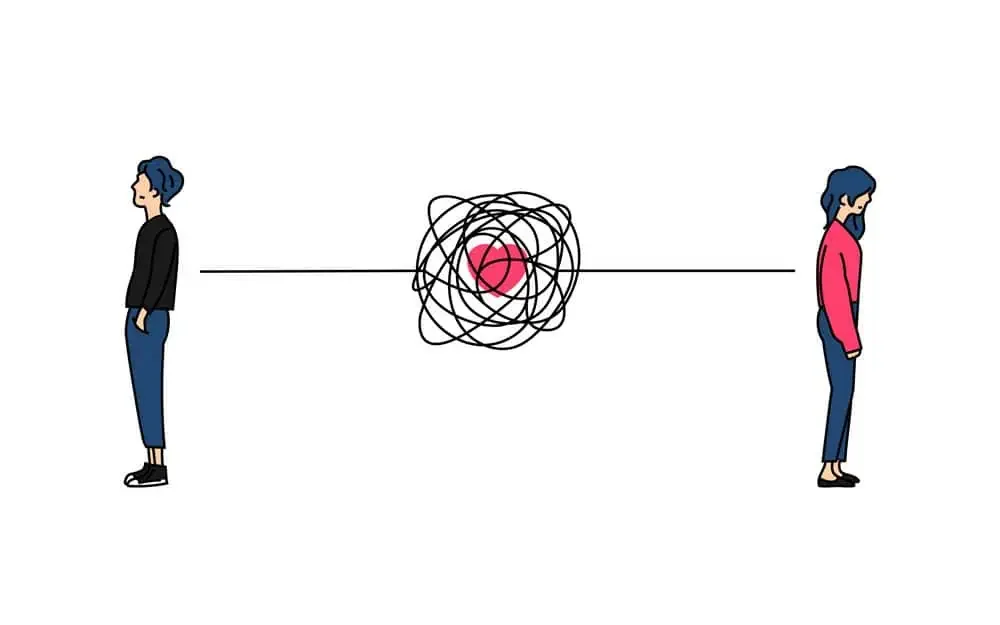
It takes two people to create a dynamic, and it can shift when one person changes how they take part.
How This Shows Up Between You
Older patterns tend to appear in small, repeated moments. You may feel a flash of panic when a message goes unanswered, or go flat and silent when your partner raises something difficult. You may apologise before anyone has accused you, or brace for criticism that has not come. Your partner meets these reactions with their own, and a cycle forms.
Some versions are very common.
One of you pursues for reassurance and the other pulls back for space, and each takes the other's move as proof of their fear.
One of you goes quiet to keep the peace while resentment builds, and the other senses distance without knowing why.
One of you reacts to a small remark as though it were a large one, because it touches something old, and the other feels they are walking on eggshells.
Over time, cycles like these wear at closeness, trust and desire. People begin to expect the same argument before it starts, and the relationship can feel like a place to be careful. Seeing your own move in the cycle is not about blame. It is about finding the one place where you have a choice. My articles on conflict avoidance in relationships and resentment in relationships describe two common versions, and why you can feel lonely in a relationship describes another.
What Individual Therapy Can Help You Do
Therapy on your own is not a place to rehearse complaints about your partner. It is a place to understand your own experience with someone who is not caught up in it. Without a partner in the room there is no one to defend against and no one to protect, which gives you room to think. That room is what makes several kinds of work possible.
See your own part. Notice what you do when things get tense, what you expect to happen, and what you tend to avoid saying.
Build perspective on the pattern. Step back from individual arguments and see the cycle you are both in.
Understand where your reactions come from. Connect present responses to earlier experiences, including old hurts that keep finding their way into the relationship.
Work through deeper rooted issues at your own pace. Some history needs more time and more privacy than couples sessions can offer.
Practise saying difficult things. Try out how to ask for what you need, set a boundary or raise a hard subject, then take what you learn back into the relationship.
Get clarity about what you want. If you are weighing whether to stay or go, therapy can help you think without pressure to decide. My article on whether to stay together or break up is written for couples, though the questions in it help on your own too.
If you would like something to work with before you start, or between sessions, my free needs and boundaries reflection is a gentle place to begin.
What Helps If Your Partner Is Not Ready to Join You
Doing this work while your partner stays out of it can be lonely and, at times, awkward. You may worry about how to talk about it, or whether your partner will feel judged. There is no single right way, but a few habits tend to make it easier on both of you.
Say what you are doing in simple terms, such as "I am going to therapy to understand my part in how we get stuck." That is an invitation to curiosity and not an accusation.
Talk about your own experience and not your partner's faults. "I noticed I go quiet when we disagree" lands very differently from "my therapist says you never listen."
Share what you learn without turning it into a lesson. Some people find that a partner becomes more curious once they see calmer, clearer behaviour and not a campaign.
Keep the door open. Your partner may join later, either in your sessions or in couples therapy, and an open door is more inviting than a push.
Be patient with the loop. When one of you changes, the other may need time before they trust it. Steady change over several weeks usually says more than a single dramatic conversation.
If you suspect that attachment patterns are part of the picture, the attachment workbooks on the resources page may help.
What the Research Says So Far
Research on individual therapy and relationship satisfaction is surprisingly limited. A 2024 systematic review looked at treatments for specific mental health conditions and what they do to relationship satisfaction. It found only seventeen studies. Most reported modest improvement in relationship satisfaction among people who completed treatment, and the authors noted that the studies had significant methodological limitations and that important gaps remain (Patel et al., 2024).
That is useful to know, and it is not a reason to doubt that therapy helps. It reflects a field that has mostly studied symptoms and not relationships, and it means anyone promising a particular relationship outcome from individual therapy is promising more than the evidence can support. What the research does support is the logic in this article. Patterns involve both people, early experience shapes how we respond, and security and emotion regulation are part of what can change.
What Individual Therapy Cannot Do
It cannot change your partner. It can change what you bring, how you respond and how clearly you see the pattern, and those changes can open new possibilities. But your partner decides what they do with them.
It also cannot recreate what happens between two people in real time. Some patterns live in the exchange itself, in the way a sentence is said and the way it is heard. For these, couples therapy lets a therapist see the loop as it happens and help both of you step out of it. If the relationship is your main concern and both of you are willing, my article on when to go to couples therapy can help you decide. For many people, the two are not rivals. Some start alone and later move into couples work, and others do the reverse.
Finally, individual therapy is not the right first step if you are afraid of your partner. Fear, being controlled, being monitored or being made to feel unsafe are not relationship patterns to be worked on by one person alone. My article on coercive control versus ordinary conflict explains the difference. If this is your situation, the National Domestic Abuse Helpline is free and open 24 hours on 0808 2000 247, and in an emergency you should call 999.
How Therapy Can Help
Individual therapy gives you room to look at the relationship from a little distance, with someone who has no stake in how it turns out. I start by hearing what brings you in and what you hope will change. We then look at the pattern as you experience it, the part you play in it and where it began for you. I work in an integrative way, drawing on attachment and relational approaches, and at a pace that suits you.
I do not tell people whether to stay or go. I work with people of every background, including LGBTQ+ clients, and with people who are in relationships, who are leaving them, or who are not sure. Some people come for a few sessions to understand one pattern, and others stay longer to work through deeper history. If you would like to know more about how I work with individuals, you can read about my individual therapy. If you have one specific question, whether one therapy session is enough explains single session therapy.
If you are not sure whether to start on your own, you are welcome to book a free 30 minute consultation, in person in London or online. It is a chance to talk through your situation and to see whether working together feels right. There is no obligation.
About the author
Mark Ryan is a BACP Accredited Psychotherapist and NCPS Accredited Relationship Therapist, and the founder of Rise and Grow Therapy, a private practice offering couples and relationship therapy across Kensington, Pimlico, and Angel, Islington in London, as well as online consultations. His approach draws first on Imago Relationship Therapy, alongside integrative relational, attachment based, Gottman, and systemic approaches. Mark works with couples of every background and relationship structure, as well as with individuals working through relational issues. Read more about individual therapy in London.
References
Bretaña, I., Alonso-Arbiol, I., Recio, P., & Molero, F. (2021). Avoidant attachment, withdrawal aggression conflict pattern, and relationship satisfaction: A mediational dyadic model. Frontiers in Psychology, 12, 794942. https://pmc.ncbi.nlm.nih.gov/articles/PMC8841843/
Eilert, D. W., & Buchheim, A. (2023). Attachment related differences in emotion regulation in adults: A systematic review on attachment representations. Brain Sciences, 13(6), 884. https://pmc.ncbi.nlm.nih.gov/articles/PMC10296607/
Mikulincer, M., & Shaver, P. R. (2020). Enhancing the broaden and build cycle of attachment security in adulthood. International Journal of Environmental Research and Public Health, 17(6), 2054. https://pmc.ncbi.nlm.nih.gov/articles/PMC7143531/
Patel, T. A., Abber, S. R., & Cougle, J. R. (2024). Do treatments for mental disorders affect relationship satisfaction? A systematic review and meta-analysis. Psychotherapy Research, 34(8), 1174 to 1185. https://doi.org/10.1080/10503307.2023.2249215
Rice, T. M., Kumashiro, M., & Arriaga, X. B. (2020). Mind the gap: Perceived partner responsiveness as a bridge between general and partner specific attachment security. International Journal of Environmental Research and Public Health, 17(19), 7178. https://pmc.ncbi.nlm.nih.gov/articles/PMC7578987/
