
Contempt in Relationships and How to Turn It Around
By Mark Ryan, BACP Accredited Psychotherapist and NCPS Accredited Relationship Therapist
Many couples describe a moment, and they often describe it with shame. Their partner says something, and before they have thought about it a sneer crosses their face, or an eye roll, or a sarcastic remark that is out of their mouth before they can stop it. Afterwards they feel uneasy, because it is not who they want to be with the person they love. If that sounds familiar, or if you are the one on the receiving end, this article is for you. Contempt is painful, and it is also a pattern that can change.
Article Summary
Contempt is a stance of looking down on a partner. It differs from anger or criticism because it speaks to who the person is and not only what they did.
It shows up in eye rolls, sarcasm, mockery and name calling, and also in silence, in a tone of superiority and in the way a person talks about their partner to others.
It hurts so deeply because it tells the receiver they are beneath their partner, which is a message about worth and belonging.
Contempt often grows slowly out of unresolved hurt, resentment and feeling unappreciated, which means it can be unwound in the same direction.
Appreciation, speaking about your own feelings and needs, repair, breaks when flooded and noticing your own contempt without self attack all help.
Contempt is a signal and not a verdict on a relationship, but when it sits alongside fear or control it may be part of abuse, and different support is needed.
What Contempt Is, and What It Is Not
Most people have felt irritated with a partner, and many have been angry. Contempt is something else. Anger says that something has gone wrong and that you want it to change. Criticism, even when harsh, is aimed at a behaviour, such as "you never help in the evenings". Contempt moves from the behaviour to the person. It says, in effect, that you are beneath me, that something is wrong with you, and that I cannot take you seriously.
Researchers who compared the two emotions found that anger and contempt often occur together but are clearly different. Anger was marked by short term attack responses and, in the longer term, reconciliation. Contempt was marked by rejection and social exclusion of the other person, both in the short and the long term (Fischer and Roseman, 2007). One way to put it is that anger still assumes you matter enough to fight with, while contempt moves a partner outside the circle.
Contempt is not the same as disagreeing strongly, raising your voice once in a bad week, or needing space. It is not proof of a bad character either. Nearly everyone has contempt available in them, and it tends to appear when we feel hurt, powerless or unseen. The article on the four communication styles that harm relationships places it alongside criticism, defensiveness and stonewalling.
How Contempt Shows Up
Contempt is often imagined as shouting, but much of it is subtle and some of it is almost polite. These are the forms couples describe most often.
Eye rolls, sighs, smirks and a curled lip. The face does it before the mind has decided.
Sarcasm and mockery, including imitating a partner's voice or repeating their words in a silly tone.
Name calling and labels such as "pathetic", "needy" or "useless", delivered as if they were simple facts.
A sense of superiority, which may sound like "I would never do that" or "someone has to be the adult here".
Silence that carries a verdict. A long look, a turned back or a pointed lack of reply differs from needing a break because it is meant to diminish.
The way a person talks about their partner to others. Jokes at a partner's expense or a running commentary on how impossible they are can be contempt even when the partner is not in the room, and it often reaches them in some form.
What It Feels Like on Each Side
Think first about what the receiver hears. Under the sarcasm or the eye roll, the message is that they are ridiculous or not worth listening to. That is a message about their worth. Human beings need to belong, and being treated as beneath someone, particularly the person who is meant to be on our side, can feel like a threat to that belonging. This is why one contemptuous remark can land harder than open disagreement.
Partners on the receiving end tend to go in one of two directions. Some fight back harder to defend their dignity. Others shrink, go quiet and begin to protect themselves by caring less. Both make it harder to find each other, and the second can look like calm when it is withdrawal. Understanding stonewalling and emotional shutdowns explains how that can take hold.
The person showing the contempt often feels something different. In the moment it can feel like certainty, even relief, and a few minutes later it can feel like shame. Both experiences are real, and both people are usually more hurt than they look.
Why Contempt Grows
Contempt rarely arrives in the first months of a relationship. More often it is built over years from small hurts that were never properly heard. A partner raises something, it is brushed aside, and the hurt goes underground. It returns as irritation, then resentment, then a settled view that this person does not care or cannot change.
That fits the research. In the same studies, contempt could develop out of anger felt earlier with the same person. It was also more likely to emerge when people felt they had little control over the other person's behaviour, felt less close to them, and had come to explain that behaviour as a fact about who the other person is (Fischer and Roseman, 2007). Anger that goes unresolved, combined with a feeling that nothing will change, is fertile ground.
Feeling unappreciated sits near the centre for many couples. When effort goes unnoticed on both sides, each person starts to keep an inner list of what the other has done wrong, and good moments become harder to see. Underneath most contempt there is a hurt that has not found a way to be said. Stress and tiredness make it worse, and for some people contempt has an older history, in the way they were spoken to growing up.
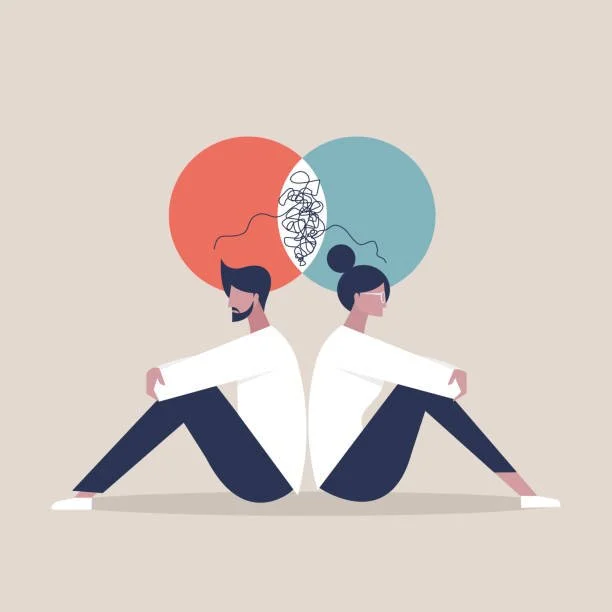
Contempt often grows slowly out of unresolved hurt, resentment and feeling unappreciated, which means it can be unwound in the same direction.
A Signal and Not a Verdict
Contempt matters, and it deserves to be taken seriously. In a study of newlywed husbands and wives, couples were observed in a conflict conversation and in a conversation about love. Negative emotion, which the researchers labelled contempt, and positive emotion, which they labelled affection, each predicted relationship quality and stability about 15 months later. How positive emotion developed over the love conversation, but not the conflict one, also predicted later satisfaction (Graber et al., 2011). So the warm moments carry weight as well as the hard ones.
It helps to be clear about what that kind of finding means. It describes groups of couples on average and says nothing certain about any one relationship. Contempt is a meaningful signal that the emotional climate between two people needs attention, and many couples change that climate.
Contempt in Same Sex and Non Monogamous Relationships
Contempt is a human pattern. Researchers who followed committed gay and lesbian couples for 12 years, recording conversations and physiology, concluded that satisfaction and stability in gay and lesbian relationships relate to similar emotional qualities as in heterosexual relationships (Gottman et al., 2003). In my experience warmth and respect matter whoever the partners are. If you are a gay or lesbian couple, gay couples therapy in London and lesbian couples therapy describe how I work.
In consensually non monogamous relationships, contempt can be aimed at a partner's other partners, at their needs for connection, or at how they handle scheduling and jealousy. A phrase such as "you always put them first" can slide into a sneer. The same remedies apply, and with more people involved a culture of respect matters even more. Jealousy in non monogamous relationships covers one common trigger.
What Helps
If you notice contempt in yourself, shaming yourself is a natural reaction, but it tends to push you into defensiveness and often leads to more contempt. Try curiosity instead. What did I feel just before that? What did I need? Noticing it is a sign of insight and not of failure, and it is the first step to choosing differently.
Contempt is often anger with the vulnerability stripped out. Underneath "you are useless" there may be "I am exhausted and I feel alone with all of this". Practise saying the second sentence. A useful shape is "I feel this about that situation, and I need this". It takes courage because it exposes more than a sneer does, but it invites a partner to help and not to defend themselves. How to stop arguing with your partner has practical examples.
Contempt is also more likely when we are flooded, with a racing heart, a tight jaw and a mind that has stopped listening. Agree a signal in advance, take a break long enough for your body to settle, and say when you will return so the break does not feel like abandonment. The free Time Out Plan for Heated Arguments is designed for this. A break is for calming down and coming back, and not for making a point.
If you are on the receiving end and you feel afraid of your partner, go first to the section on abuse below. Otherwise, you are allowed to say that it hurts. A calm moment is better than the middle of an argument, and naming the behaviour works better than naming the person. "When you roll your eyes while I am talking, I feel dismissed and I stop wanting to share" is clearer and harder to wave away than "you are always so contemptuous". You can also set a limit, for example "I want to hear what you are upset about, and I will not carry on if I am being mocked".
Try to hold two things together. The contempt is not your fault, and it may carry a hurt of your partner's that has not found words. That does not make it acceptable, and it does not mean it is yours to fix. Look after yourself in the meantime, with friends or your own therapy, and remember you are allowed to want to be spoken to with respect.
For both of you, contempt thrives where good things go unseen. Many couples find that making appreciation a deliberate habit loosens resentment, because the mind begins to look for what is going right as well as what is wrong. Say thank you for specific things, notice effort even when the result is imperfect, and tell your partner what you admire in them. The article on gratitude has more ideas.
Everyone slips, so the aim is not to never show contempt. The aim is to come back. A repair might sound like "That came out with a sneer and I am sorry. What I meant was that I felt dismissed". The partner who was hurt can say what they need to hear, and both can name what was underneath. Repairing after a fight offers a step by step guide to rebuilding safety and trust.
There is encouraging evidence that contempt can ease. In a randomised trial of couples becoming parents, those who attended a psychoeducational workshop showed less contempt from husbands during conflict three months after the birth than couples who did not. The authors noted that change after an intervention can be gradual (Shapiro, Gottman and Fink, 2015). Contempt took time to build and it takes time to soften, and a slow start is not a failure. Try one small shift this week, such as one specific appreciation a day, one sentence about a feeling in place of a sneer, or one agreed time out.
When Contempt May Be Part of Abuse
Contempt does not always sit inside an ordinary difficult relationship. In some relationships one person repeatedly belittles, mocks and humiliates the other as a way of controlling them. The difference often shows in how it feels for the person on the receiving end. In a conflict that has gone badly, both people may feel hurt and both may say things they regret. In coercive control, one person tends to feel afraid, smaller, watched or unable to speak freely, and may begin to change what they say, wear or do to avoid the next put down.
If you recognise some of this, for example walking on eggshells, being cut off from friends or being made to doubt your own memory, none of it is your fault, and couples therapy is not usually the right first step. You can read more on coercive control versus conflict and signs of emotional abuse in a relationship. Support is available.
The National Domestic Abuse Helpline is free and open 24 hours on 0808 2000 247, for women who are afraid of a partner.
The National LGBT+ Domestic Abuse Helpline from Galop is on 0800 999 5428, and its opening hours are listed at galop.org.uk.
The Men's Advice Line is on 0808 8010327, from 10am to 5pm on weekdays, and welcomes men, trans and non binary people.
If you are in immediate danger, call 999.
If you are the person whose behaviour frightens your partner, specialist support for abusive behaviour can help, and reaching out is a sign of courage.
How Therapy Can Help
Couples sometimes fear that naming contempt in a therapy room will make it worse, or that a therapist will take sides. Good couples therapy does neither. The work is usually to slow the exchanges down, to understand what each person feels under the sneer or the shutdown, and to help both people say it in a way the other can hear. Partners often find that contempt has been protecting a great deal of hurt, and that when the hurt is heard, the contempt eases.
I work with couples of all kinds, including same sex couples and those in consensually non monogamous relationships. Many people ask when to go to couples therapy, and earlier is usually easier.
If you have read this far, you probably care about the relationship, or about the person you want to be inside it. That is a good starting point. If you would like help with the patterns between you, I offer a free 30 minute consultation, in person in London or online, for couples and individuals of all kinds.
About the Author
Mark Ryan is a BACP Accredited Psychotherapist and NCPS Accredited Relationship Therapist, and the founder of Rise and Grow Therapy, a private practice offering couples and relationship therapy across Kensington, Pimlico, and Angel, Islington in London, as well as online consultations. His approach draws first on Imago Relationship Therapy, alongside integrative relational, attachment based, Gottman, and systemic approaches. Mark works with couples of all kinds, including LGBTQ+ couples and those in non traditional relationship structures such as consensual non monogamy, as well as with individuals working through relational issues.
References
Fischer, A. H., & Roseman, I. J. (2007). Beat them or ban them: The characteristics and social functions of anger and contempt. Journal of Personality and Social Psychology, 93(1), 103 to 115. https://doi.org/10.1037/0022-3514.93.1.103
Gottman, J. M., Levenson, R. W., Gross, J., Frederickson, B. L., McCoy, K., Rosenthal, L., Ruef, A., & Yoshimoto, D. (2003). Correlates of gay and lesbian couples' relationship satisfaction and relationship dissolution. Journal of Homosexuality, 45(1), 23 to 43. https://doi.org/10.1300/j082v45n01_02
Graber, E. C., Laurenceau, J. P., Miga, E., Chango, J., & Coan, J. (2011). Conflict and love: Predicting newlywed marital outcomes from two interaction contexts. Journal of Family Psychology, 25(4), 541 to 550. https://doi.org/10.1037/a0024507
Shapiro, A. F., Gottman, J. M., & Fink, B. C. (2015). Short term change in couples' conflict following a transition to parenthood intervention. Couple and Family Psychology Research and Practice, 4(4), 239 to 251. https://doi.org/10.1037/cfp0000051
